
Day Sixteen of Lent – The Greatest of Miracles
March 7, 2026
2 Thessalonians 3:3
March 7, 2026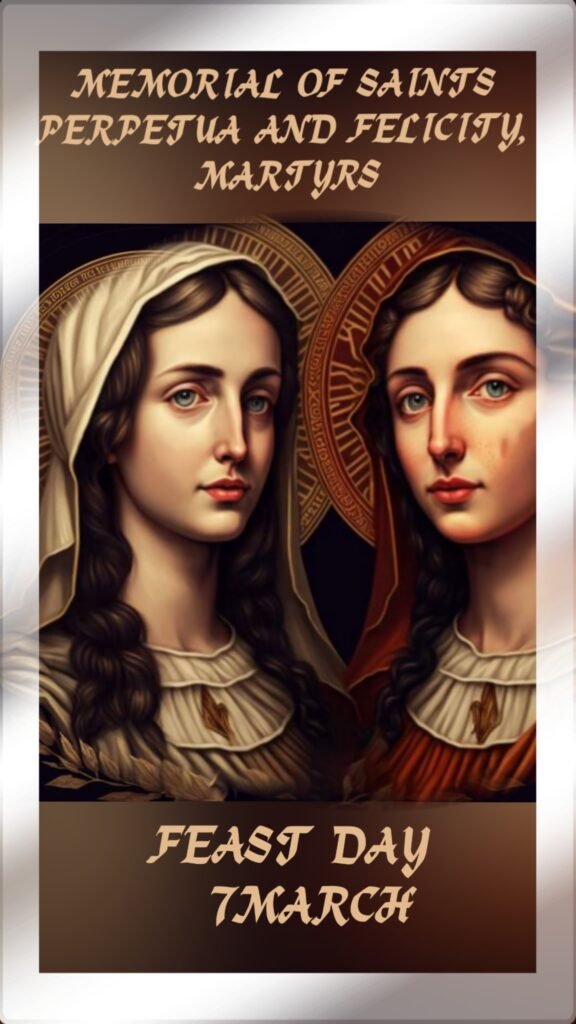
FEAST OF SAINTS PERPETUA AND FELICITY, MARTYRS
FEAST DAY – 7th MARCH

Perpetua and Felicity (Latin: Perpetua et Felicitas) were Christian martyrs of the 3rd century.(Late Second Century – 203 A.D). Vibia Perpetua was a recently married well educated noblewoman, said to have been 22 years old at the time of her death, and mother of an infant she was nursing. Felicity, a slave imprisoned with her and pregnant at the time, was martyred with her. They were put to death at Carthage in the Roman province of Africa.
Centuries ago, in the desert lands of North Africa, there was once a thriving Catholic Church. Dioceses, bishops, theologians, shrines, cemeteries, schools, monasteries, convents, and saints filled the towns hugging the southern coast of the Mediterranean Sea. This vibrant Catholicism gave birth to, and was inspired by, the witness of numerous martyrs.
Many of their names are known, among them today’s saints, Felicity and Perpetua. Few documents in Church history can match the raw power of the first person, eye-witness account of the assassination of Perpetua and Felicity. It is a gripping narrative filled with breathtaking dramatic detail. The reader can almost feel the hot sand of the arena warming the feet, a gentle sea breeze caressing the cheeks, and the sweaty crowd, their roar for bloodlust echoing through the dry air.
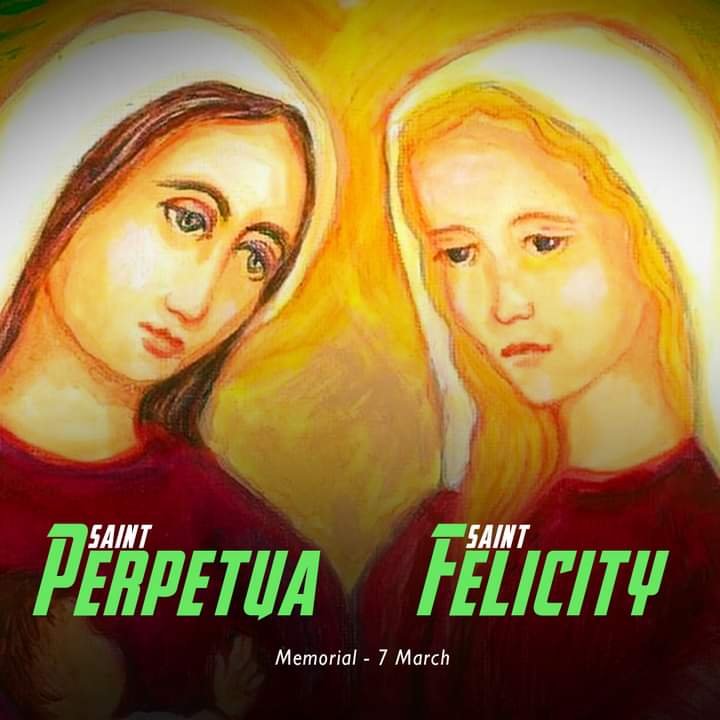
The Passion of Perpetua and Felicity narrates their death. According to the narrative, a slave named Revocatus, his fellow slave Felicitas, the two free men Saturninus and Secundulus, and Perpetua, who were catechumens – that is, Christians being instructed in the faith but not yet baptized – were arrested and executed at the military games in celebration of the Emperor Septimius Severus’ birthday.
To this group was added a man named Saturus, who voluntarily went before the magistrate proclaiming to be a Christian. Perpetua’s first person narrative was published posthumously as part of the Passion.
Perpetua was imprisoned in Carthage in the days leading up to her martyrdom. She described these days and all that she endured in her diary, the physical and emotional torments that she suffered in the prison leading up to her martyrdom. Perpetua suffered physically due to the heat, rough prison guards, and the cessation of regular breastfeeding. Perpetua also described how the prison conditions improved after she and other martyrs were moved to another part of the prison. Her physical torment was also eased after she was able to breastfeed her child. Perpetua described her bodily ailments in detail.
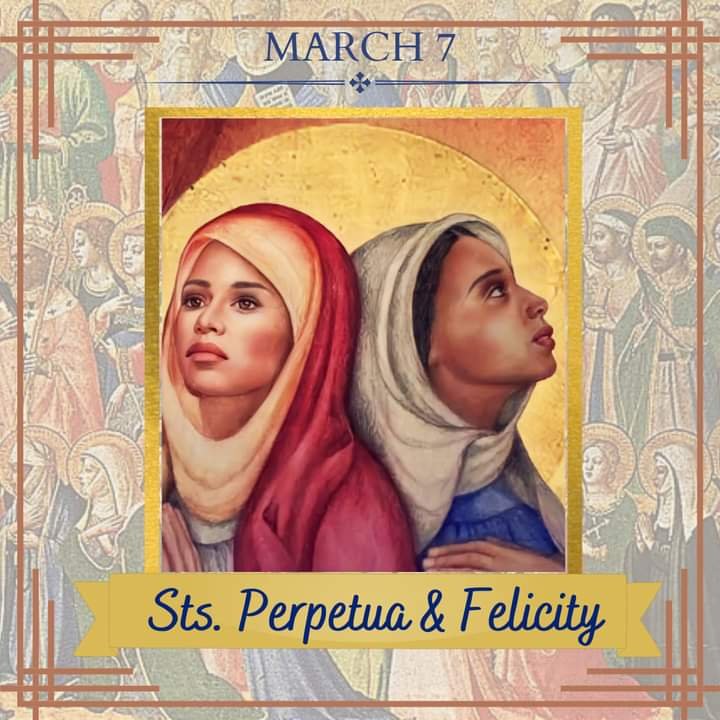
Her child would be raised by Christian women in Carthage. Perpetua, in her own hand, recorded the events leading up to her martyrdom, while an eye-witness to her death completed the text later. When they were first thrown into the arena, Perpetua and Felicity were attacked by a rabid heifer, which was chosen because it shared the same sex as its victims. The young women were grievously injured by the mad cow and then momentarily removed from the arena until gladiators were brought in to conclude the day’s spectacle.
The executioners carried out their duties quickly, though Perpetua had to guide the gladiator’s sword to her throat after he first painfully struck a bone instead of a vein. As the narration states, “Perhaps such a woman…could not die unless she herself had willed it.” Perpetua and Felicity were imprisoned together, suffered together, and died together in 203 A.D. in Carthage, North Africa, along with other noble martyrs whose names are preserved in the same account.
The vivid description of their deaths was so moving that it was faithfully preserved down through the centuries and has come to us largely intact. Apart from the New Testament writings themselves, only a few documents from the early Church pre-date the passion narrative of Perpetua and Felicity. The Church in North Africa so often read the account of Perpetua and Felicity in its public liturgies that Saint Augustine, a North African bishop living two hundred years after their martyrdoms, had to remind his faithful that the narrative was not on a par with Scripture itself.
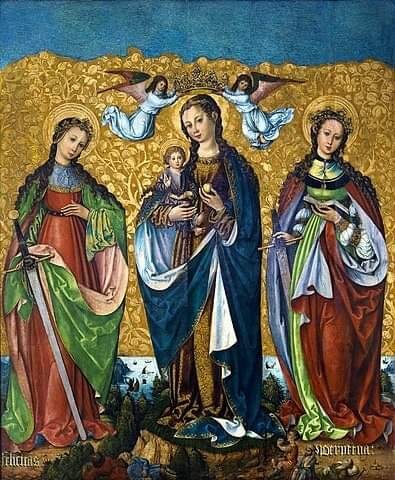
In Carthage a basilica was afterwards erected over the tomb of the martyrs, the Basilica Maiorum, where an ancient inscription bearing the names of Perpetua and Felicitas has been found. Saints Felicitas and Perpetua are among the martyrs commemorated by name in the Roman Canon of the Mass.
The feast day of Saints Perpetua and Felicitas, 7 March, was celebrated even outside Africa and is entered in the Philocalian Calendar, the 4th-century calendar of martyrs venerated publicly at Rome. When Saint Thomas Aquinas’ feast was inserted into the Roman calendar, for celebration on the same day, the two African saints were thenceforth only commemorated.
This was the situation in the Tridentine Calendar established by Pope Pius V, and remained so until the year 1908, when Pope Pius X brought the date for celebrating them forward to 6 March. In the 1969 revision of the General Roman Calendar the feast of Saint Thomas Aquinas was moved, and that of Saints Perpetua and Felicity was restored to their traditional 7 March date.
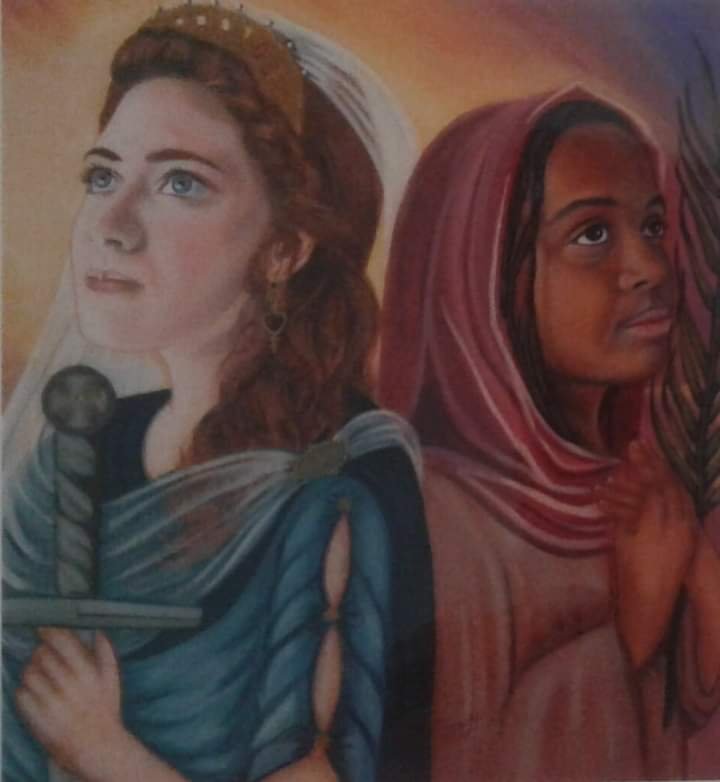
Other Churches, including the Lutheran Church and the Episcopal Church, commemorate these two martyrs on 7 March, never having altered the date to 6 March. The Anglican Church of Canada, however, historically commemorated them on 6 March (The Book of Common Prayer, 1962), but have since changed to the traditional 7 March date (Book of Alternative Services, 1985).
Perpetua is the patron of cattle, death of children, and martyrs, and Felicity is patron of death of children, martyrs, sterility, to have male children and widows.
Symbols used for St. Perpetua are the wild cow, spiked ladder guarded by a dragon and for St. Felicity, symbols used are seven swords, a cauldron of oil and sword, sword with seven heads and eight palms.
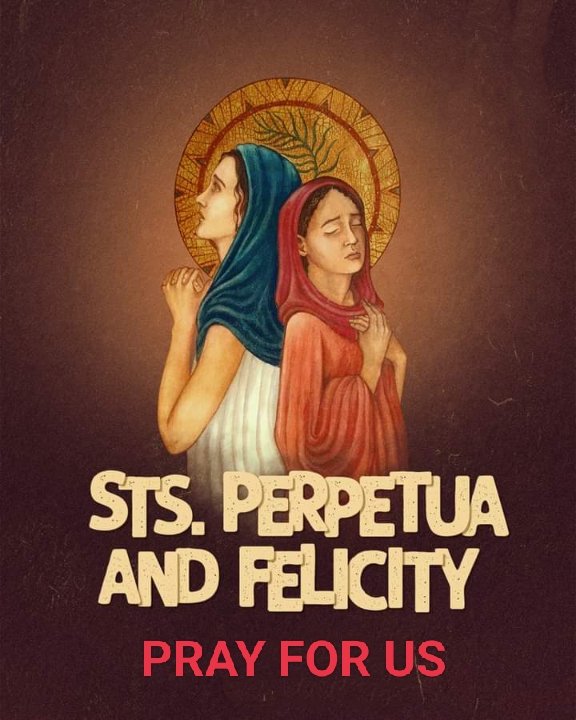
CONTEMPLATING THE LIVES OF SAINTS PERPETUA AND FELICITY (MARTYRS OF CARTHAGE, – 203 AD)
Saints Perpetua and Felicity are among the most beloved martyrs of the early Church. They were young Christian women who were executed in 203 AD in Carthage (North Africa) during the persecution of Christians under Septimius Severus.
Their story is one of the earliest and most vivid eyewitness accounts of Christian martyrdom, preserved in a document called The Passion of Saints Perpetua and Felicity. Remarkably, much of this account appears to have been written by Perpetua herself, making it one of the oldest surviving writings by a Christian woman.
Their feast day is celebrated on 7 March
FAITH STRONGER THAN THE SWORD: THE MARTYRDOM OF SAINTS PERPETUA AND FELICITY
The sun rose slowly over Carthage, the great Roman city on the North African coast. The streets were already buzzing with excitement.
It was the day of the public games.
Crowds poured toward the amphitheatre. Vendors shouted. Soldiers marched. The arena waited for blood.
But beneath the roaring excitement of the city, inside a dark prison cell, a different drama was unfolding.
Perpetua: The Noble Young Mother
There sat a young woman named Perpetua. She was only twenty-two. Her clothes and bearing revealed that she came from a noble family. But now she was a prisoner – condemned to die because she would not deny Christ. In her arms she held her tiny baby.
Her father, an elderly man with tired eyes, rushed into the prison again. He had come many times before. “Daughter,” he pleaded, his voice trembling. “Have pity on my grey hair. Think of your child. Offer the sacrifice to the emperor. Just say the words.”
Perpetua looked at him gently. Nearby stood a small clay water jug. She pointed to it. “Father,”_ she asked quietly, _“can this vessel be called anything other than what it is?” “No,” he answered. “Neither can I call myself anything other than what I am – a Christian.” Her father collapsed in grief. But Perpetua’s face remained calm.
The Slave Who Shared Her Courage
Beside her in the prison sat another woman. Her name was Felicity. She was a slave.
She was also eight months pregnant. In Roman law a pregnant woman could not be executed, which meant she might be separated from her companions. But Felicity did not fear death.
She feared only being separated from those who would witness to Christ. So she prayed. “Lord, let my child be born soon, so that I may suffer with my brothers and sisters.” Her prayer was answered.
Two days before the execution she went into labor. The pains were severe. Someone nearby mocked her:
“If you cry now, what will you do when the beasts attack you?”
Felicity answered with quiet conviction:
“Now it is I who suffer. But then Another will suffer in me, because I will suffer for Him.” Soon a little girl was born. The baby was taken by a Christian woman to be raised in safety. Felicity was free to face martyrdom.
Perpetua’s Mystical Visions
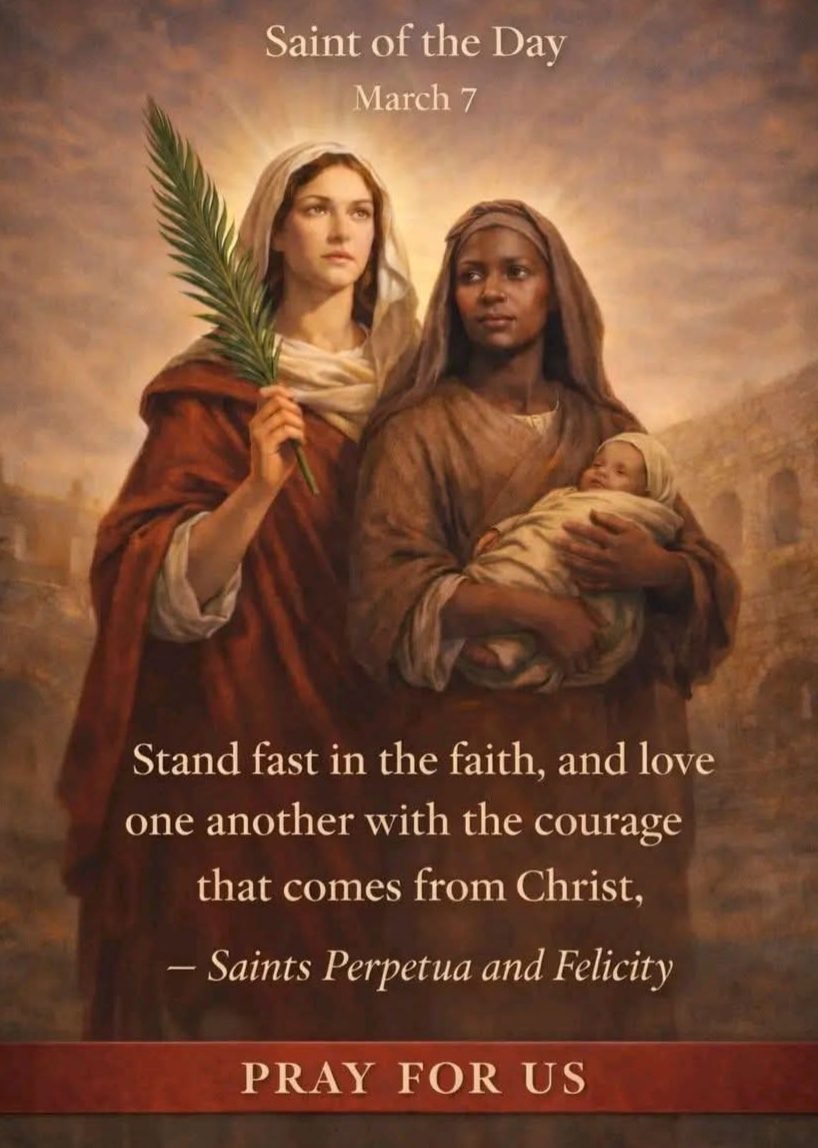
1 Vision of the Heavenly Ladder
While waiting for execution, Perpetua had a dream. She saw a great golden ladder reaching to heaven. At its base lay a terrible dragon waiting to devour those who climbed. Her teacher climbed first and turned back to her. “Perpetua, I am waiting for you.” She stepped forward. Placing her foot on the dragon’s head, she climbed the ladder. At the top she entered a beautiful garden where Christ welcomed her. When she awoke, she knew what the vision meant. Her death would be her victory.
2 Vision of Her Dead Brother
Perpetua had a little brother named Dinocrates, who had died young. In another vision she saw him suffering. She prayed intensely for him. Later she saw him again – now healthy and joyful, drinking from a fountain. Early Christians saw this as a powerful sign of the power of prayer for the dead.
The Martyrdom in the Arena
The day of the games arrived. The amphitheatre thundered with noise. Thousands of spectators filled the stands. The prisoners were led into the arena. But witnesses noticed something strange. Instead of fear, the Christians walked with serenity. Perpetua and Felicity stood together.
A noblewoman and a slave. Equal now in the eyes of God. The crowd demanded their suffering. A wild cow was released into the arena. It charged violently. Felicity was thrown first. Then Perpetua was tossed to the ground. But something extraordinary happened. Perpetua stood up calmly. Seeing Felicity injured, she went to her friend and helped her rise.
Then she noticed that her tunic had been torn. Even in that moment she adjusted her clothing, concerned for modesty. The crowd fell strangely silent. Finally the executioners were ordered forward. The martyrs exchanged the kiss of peace.
A young gladiator approached Perpetua, trembling. His hand shook so badly he could not strike. So Perpetua gently guided his sword to her throat. And in that moment the arena witnessed a victory far greater than the games. Two women had conquered fear. They had conquered death. Their faith proved stronger than the sword.
Impact on the Early Church
The story of Perpetua and Felicity spread rapidly through the Christian world.
It became one of the most influential martyr narratives in Christian history.
Even Augustine of Hippo preached sermons about them two centuries later.
Their witness demonstrated that in Christ:
* social barriers disappear (a noblewoman and a slave dying together)
* women could be heroic witnesses of faith
* martyrdom was seen as union with Christ’s suffering.
Veneration in the Church
Saints Perpetua and Felicity are among the very few early female martyrs named in the Roman Canon of the Mass.
They appear in the ancient Eucharistic prayer alongside saints such as:
* Agatha of Sicily
* Lucy of Syracuse
* Cecilia of Rome
Their memory has been honored continuously since the 3rd century.
Patronage
They are patrons of:
* mothers
* expectant mothers
* widows
* those suffering persecution.
PRAYER
O God, at the urging of whose love the Martyrs Saints Perpetua and Felicity defied their persecutors and overcame the torment of earth, grant, we ask, by their prayers, that we may ever grow in your love.
Through our Lord Jesus Christ, your Son, who lives and reigns with you in the unity of the Holy Spirit, one God, for ever and ever. Amen

Saints Perpetua and Felicity, pray for us.