
SPIRITUAL INSIGHTS INTO THE LIFE OF ST. FAUSTINA KOWALSKA
October 5, 2026
Psalm 55:22
October 6, 2026
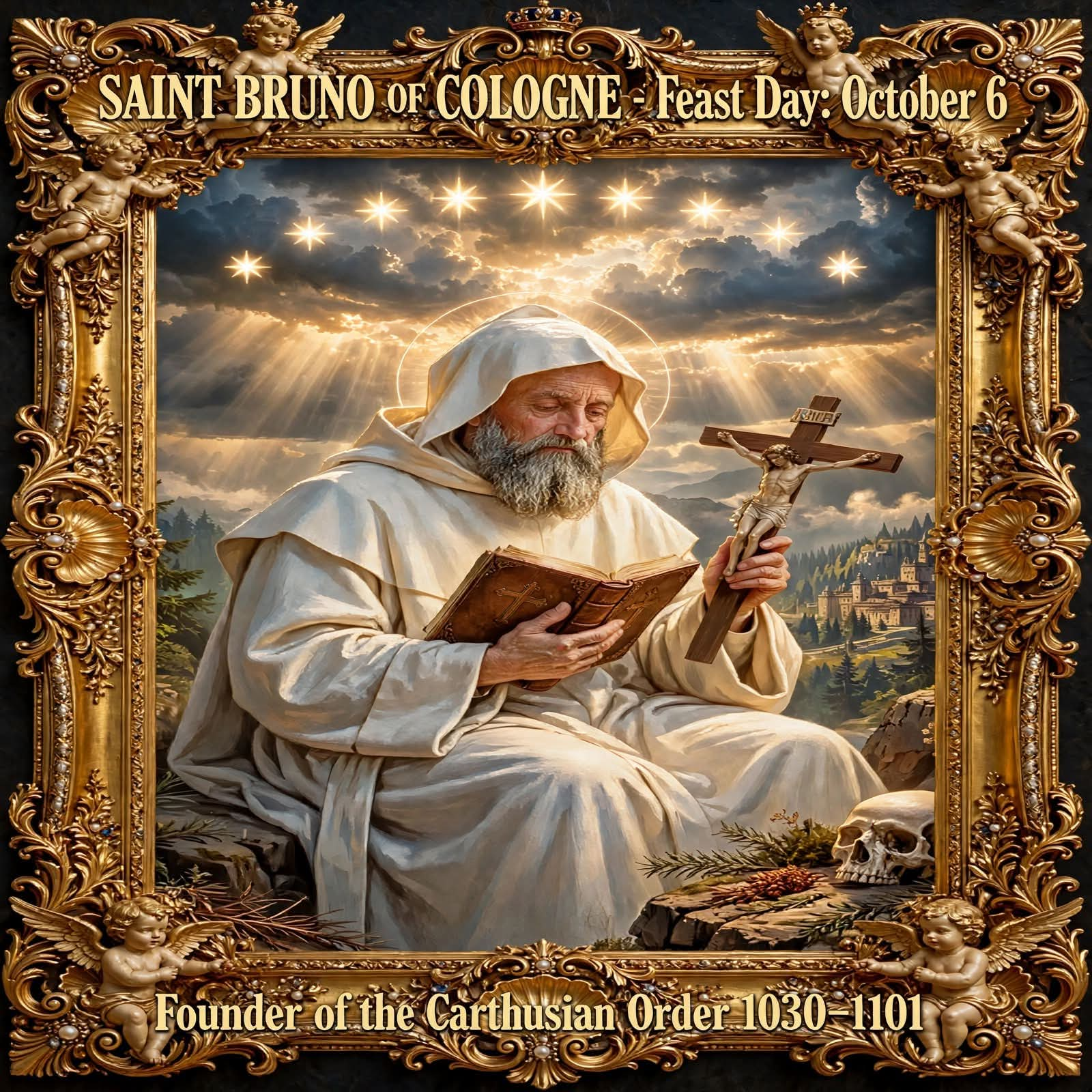
MEMORIAL OF SAINT BRUNO, CARTHUSIAN ORDER FOUNDER – 6th OCTOBER

St. Bruno (1030-1101) was born to a noble and prominent family in Cologne, Germany. He was well educated and excelled in his studies, and became a priest around the year 1055. He went on to direct and teach at the episcopal school at Reims for many years, earning a reputation as a learned scholar. After also serving as the chancellor of his archdiocese, he and a few companions left their positions in the diocese in order to follow a path of greater religious observance.
In 1084 Bruno settled in the Chartreuse Mountains in France with a small group of scholars who, like himself, desired to become contemplative monks. This was the beginning of the Carthusian order founded by St. Bruno, combining the solitary life of hermits with the conventual life of religious observance. These alpine monks embraced a strictly disciplined life of poverty, labor, prayer, and fasting.

de Crayer, Gaspar; St Bruno; York Museums Trust; http://www.artuk.org/artworks/st-bruno-7774
After living six years of strict asceticism, St. Bruno was called to Rome by the Pope, who was his former student, to assist with the troubles and controversies rocking the Church. Bruno became a close advisor to the Pope and was allowed to return to monastic life only if he remained nearby within Italy, leading Bruno to establish a second Carthusian monastery there in 1095. St. Bruno wrote many manuscripts and commentaries during his life. His feast day is celebrated on October 6th.
This founder of the Carthusian order of monks was at first not a hermit at all. For eighteen years he was a professor of theology in his own country of France. He tried his best to bring his students closer to God. Then he was given an important position in the diocese of Rheims. He left his native Cologne to study in Rheims, France, as a young man and was ordained a priest around 1055.

Aware of Bruno’s obvious talents, the Bishop of Rheims demanded that the young priest remain in his diocese, where Bruno became the head of Rheims’ most illustrious school for almost two decades and then Chancellor of the diocese. Bruno’s trajectory was, at this point in his life, typical of talented, educated, and well-connected priests of his era.
He was destined to become a good, scholarly, and politically aware medieval bishop, the kind whose graves fill the floors and stuff the side chapels of many Gothic cathedrals. But a bad bishop altered the arc of Bruno’s trajectory. Bruno’s bishop-patron died and was succeeded by a corrupt aristocrat who had bought his office.

This ecclesiastic had little concern for the Church except as a well of money and power from which he could freely drink. Revolt, sharp tensions, recriminations, and violence ensued. Everyone was damaged. Bruno withdrew from the scene, partly to avoid being named a bishop himself and partly to reevaluate what prize he was truly seeking in life.
Bruno and some companions then sought out a well-known hermit in Southern France who, a few years later, would go on to found the Monastery of Citeaux, the mother foundation of the Cistercian Order. Citeaux was the very same monastery which had such an influence on Bruno’s contemporary Saint Bernard of Clairvaux. But Bruno was not meant to be a Cistercian. Still searching, Bruno and six companions approached the Bishop of Grenoble, France.

The Bishop was favorable to their plan and granted them a remote location in the French Alps called Chartreuse. It was 1085. Saint Bruno’s successors reside at the Grande Chartreuse to this day, living the part hermit, part community of prayer, part work, part study, all poor, and all silent existence of Carthusian monks that Bruno envisioned. Though Bruno founded the Grande Chartreuse, he did not remain there for long.
A former pupil of Bruno’s had become Pope, and he needed Bruno’s hand on the rudder to help him navigate the ship of the Church in the rough seas of medieval ecclesiastical politics. So Bruno moved to Rome and lived in a cell amidst the crumbled arches and half walls of the Baths of Diocletian. His every intention of returning to the Grande Chartreuse was frustrated. The Pope compelled Bruno to remain in Italy in case his services were needed, even as the Pope and his court were on the run from determined enemies.

Resigned to his exile, and refusing an appointment as bishop in Southern Italy, in about 1094 Bruno and some followers spawned a mini-Chartreuse in Calabria, Italy, called La Torre, although this second foundation was later to be absorbed into the Cistercian Order. Bruno died there, living in silence as a monk.
He was never formally canonized and left no rule for his Order, leaving that task to a successor. Saint Bruno had a burning love for the Holy Eucharist and for the Virgin Mary.
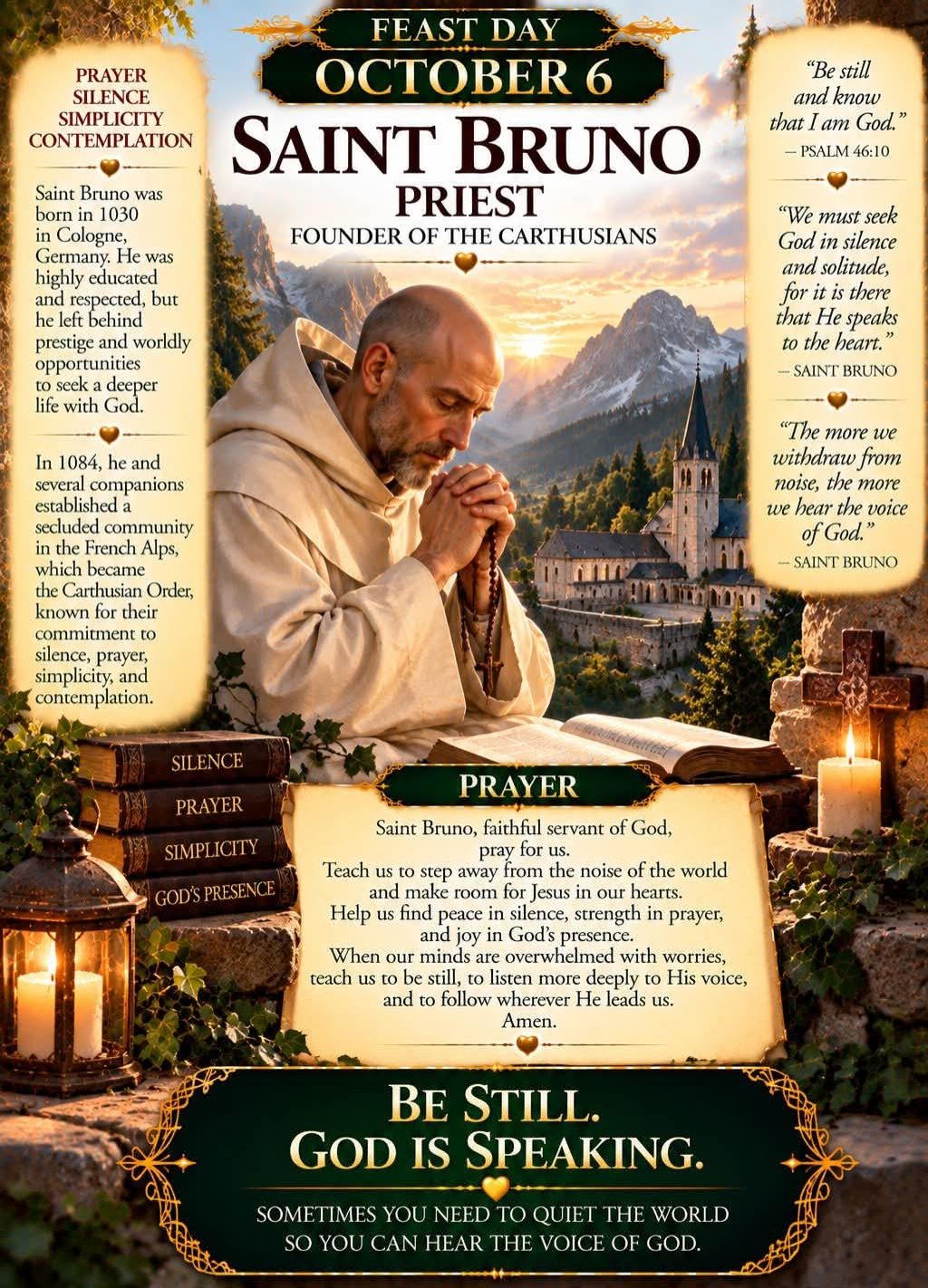
Silence was also his muse. God speaks beautifully through His creation, but one must “hear“ God’s silence to understand Him. Silence is a powerful form of speech, a negative word which God, as the Father of a large family, often uses to communicate.
The internal word is not less of a word because it remains unspoken. A word is an internal mental tool for organizing thought before it is a means of communication. God’s own internal Word was so powerful that it became flesh and blood, a living Word more powerful than mere spoken language.

Words are a form of action, but they can also limit meaning. God speaks most deeply in the action of creation, through His Son and in silence. As lovers know, a glance, a touch, a smile, a thought is sufficient. Words may add to these things, but they can also subtract from them.
It has been said that even if a marble statue of Saint Bruno could stretch open its mouth, he would still keep his vow and remain silent, for “When words are many, transgression is not lacking” (Prv 10:19). Saint Bruno’s feast is celebrated on 6th October.
CONTEMPLATING THE LIFE OF SAINT BRUNO, PRIEST
THE SILENT FLAME
The school at Rheims was filled with voices as students gathered around parchments, eagerly awaiting their lecture. At the centre stood Bruno of Cologne, a respected teacher known for his wisdom, clarity and intellectual brilliance. Among his students was Eudes of Châtillon, who would later become Pope Urban II.
Yet beneath Bruno’s scholarly achievements was a deep concern for the corruption he witnessed within the Church. He saw ambition, simony and abuse of power weakening the shepherds of God’s people. As Chancellor of Rheims, he courageously opposed his archbishop when he was accused of tyranny and simony. Bruno chose truth and justice even when doing so brought personal hardship.
THE MOUNTAIN OF SILENCE
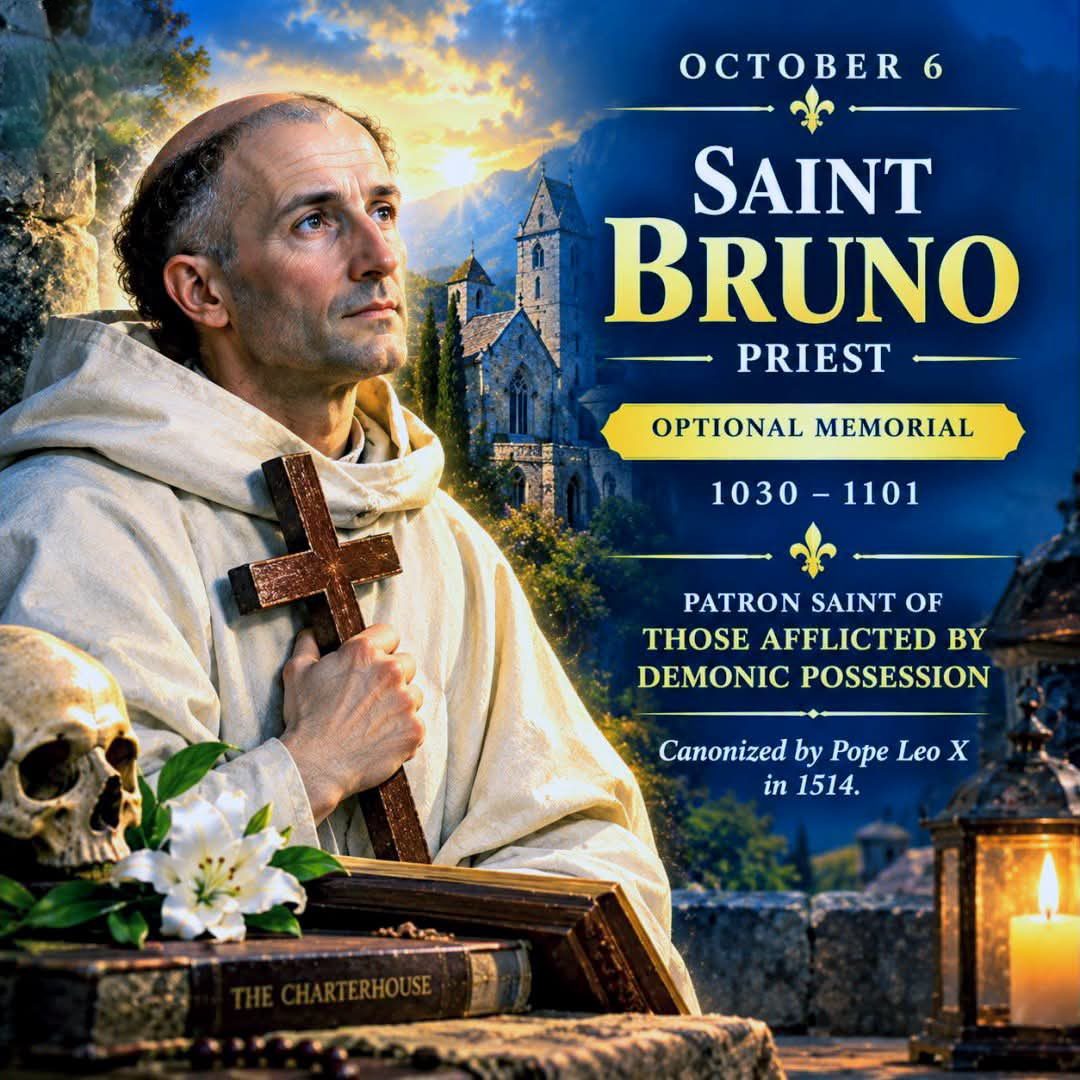
In 1084, Bruno withdrew from the world with six companions and journeyed to the remote Chartreuse Mountains near Grenoble. With the assistance of Saint Hugh, Bishop of Grenoble, they established a small community of hermits. Each monk lived largely in solitude, dedicating himself to prayer and manual work, while coming together for the liturgy and certain communal meals.
This way of life combined solitude with fraternity. It was neither complete isolation nor ordinary community life, but a communion of hermits united in prayer. From Chartreuse came the name Carthusians, whose austere tradition would preserve a profound spirit of contemplation within the Church.
SUMMONED TO ROME
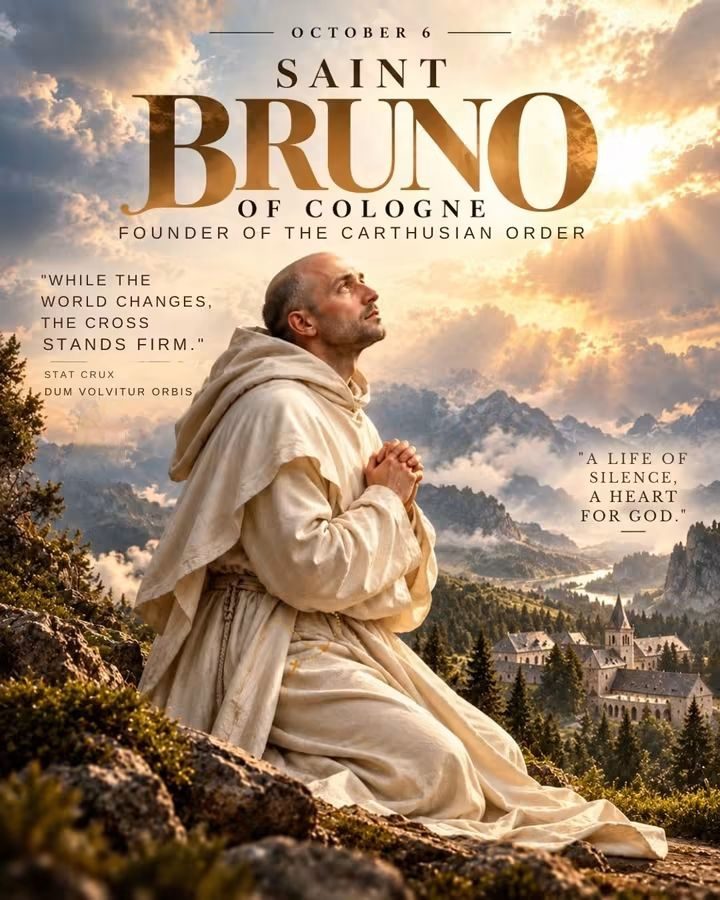
Bruno’s life of hiddenness was interrupted when his former student, Pope Urban II, summoned him to Rome. The Pope was leading the Church through a period of reform, confronting corruption and defending the freedom of the Church from worldly interference.
Bruno obediently went to Rome and offered his wisdom and spiritual counsel. Urban II wished to honour him with ecclesiastical advancement, but Bruno declined. He did not desire titles or worldly recognition. His heart remained fixed on the quiet life of prayer and contemplation.
A HERMIT WITH KINGS
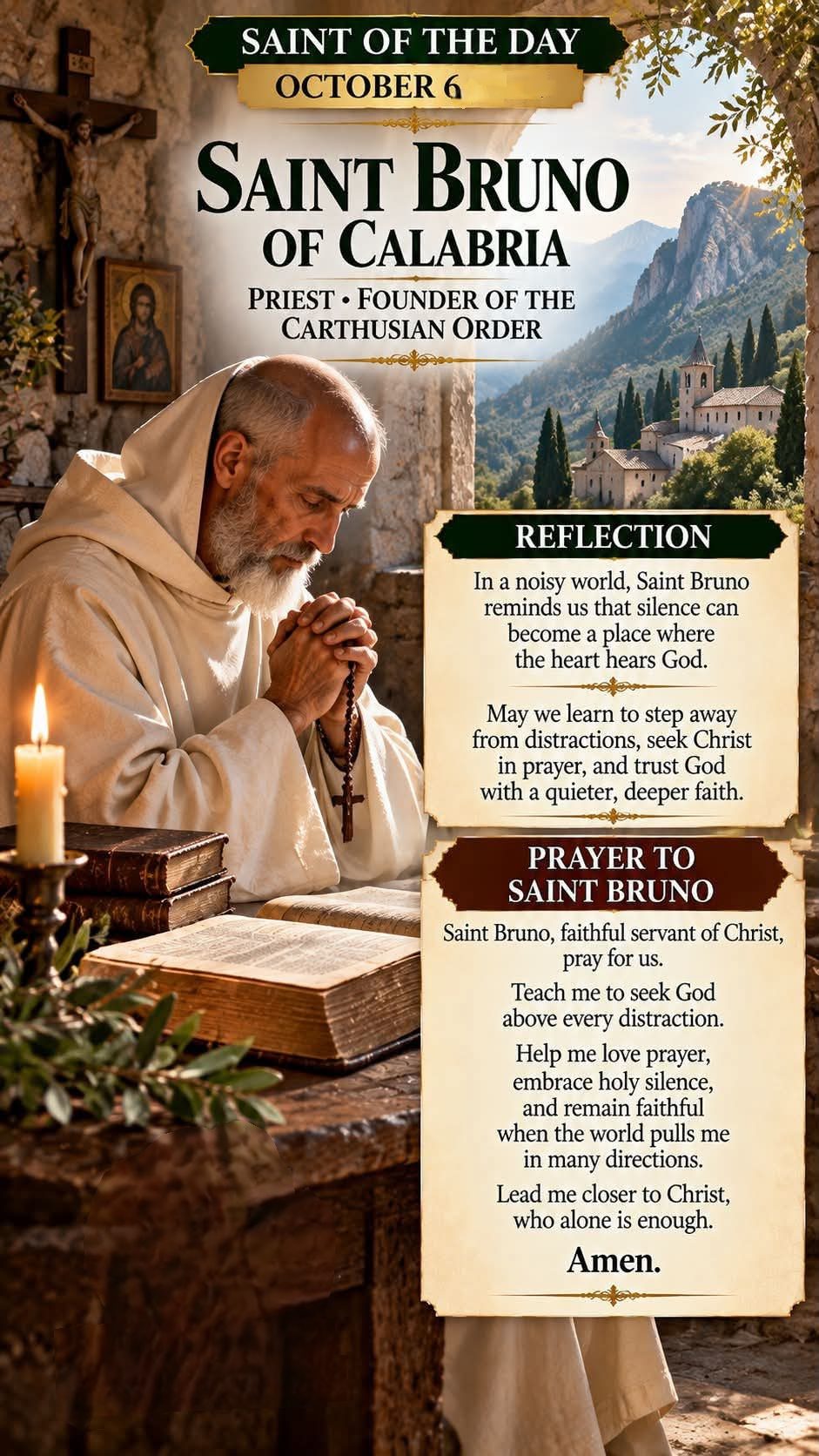
With the Pope’s blessing, Bruno eventually withdrew to Calabria. Count Roger of Sicily respected his wisdom and sought his counsel in matters of governance. Bruno was willing to advise him, but he remained determined to live as a hermit.
In the solitude of the Calabrian hills, Bruno and his companions established another place of prayer. Although rulers sought his advice, Bruno continually returned to the silence of his hermitage. His life demonstrated that true influence does not always come through public position, but can flow quietly from holiness and wisdom.
DEATH IN HIDDENNESS
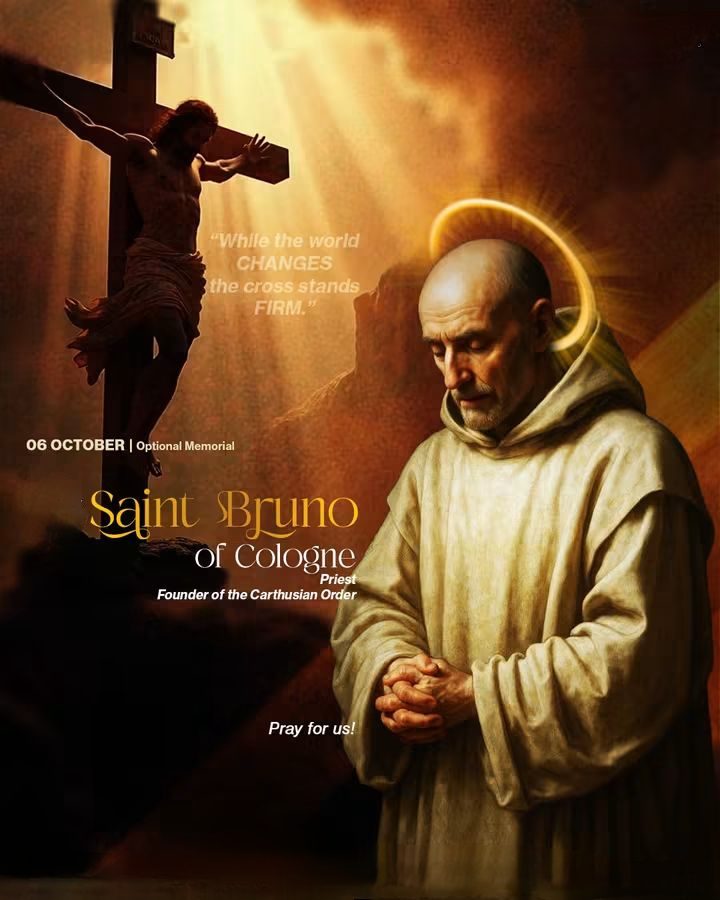
In 1101, Bruno died peacefully in Calabria. He left behind no vast collection of theological writings or great public monuments. His lasting legacy was the community he had founded and the contemplative tradition that continued through the Carthusians.
After his death, Bruno was venerated as a holy man, and devotion to him spread in Calabria and beyond. His holiness became increasingly recognized throughout the Church, and in 1514 Pope Leo X officially confirmed his veneration.
THE ROSE GARDEN OF SILENCE
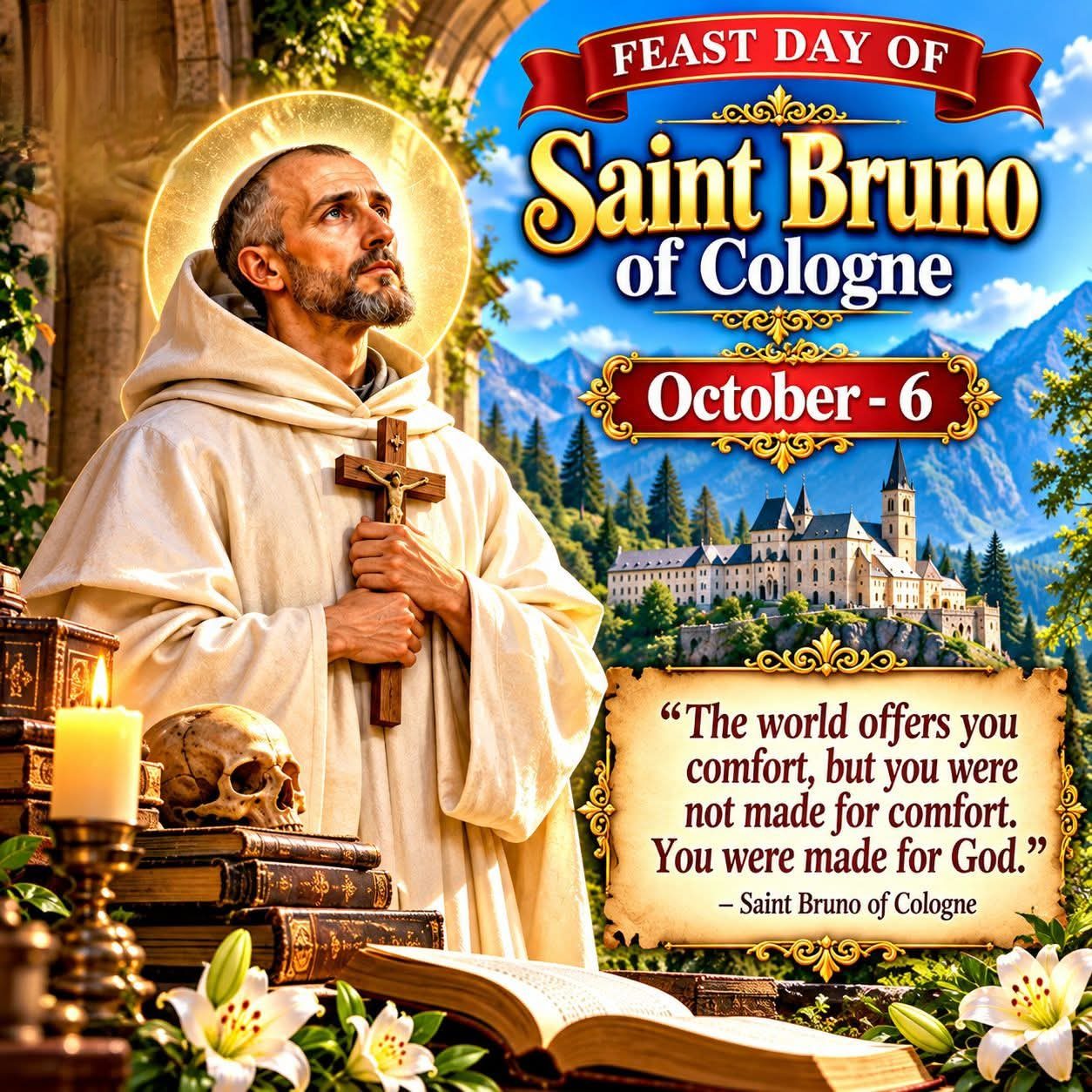
The silence Bruno sought was never emptiness. It was a sacred interior space where the presence of God could be heard more clearly than the noise of the world. His life reminds us that silence can become a place of encounter, prayer and transformation.
Saint Bruno remains a beautiful paradox. He was a brilliant teacher who chose a hidden life, a man who withdrew from public acclaim yet continues to speak through his example. His life teaches that holiness does not require recognition. Sometimes the greatest work God accomplishes in a person happens quietly, away from the eyes of the world.
PRAYER TO SAINT BRUNO
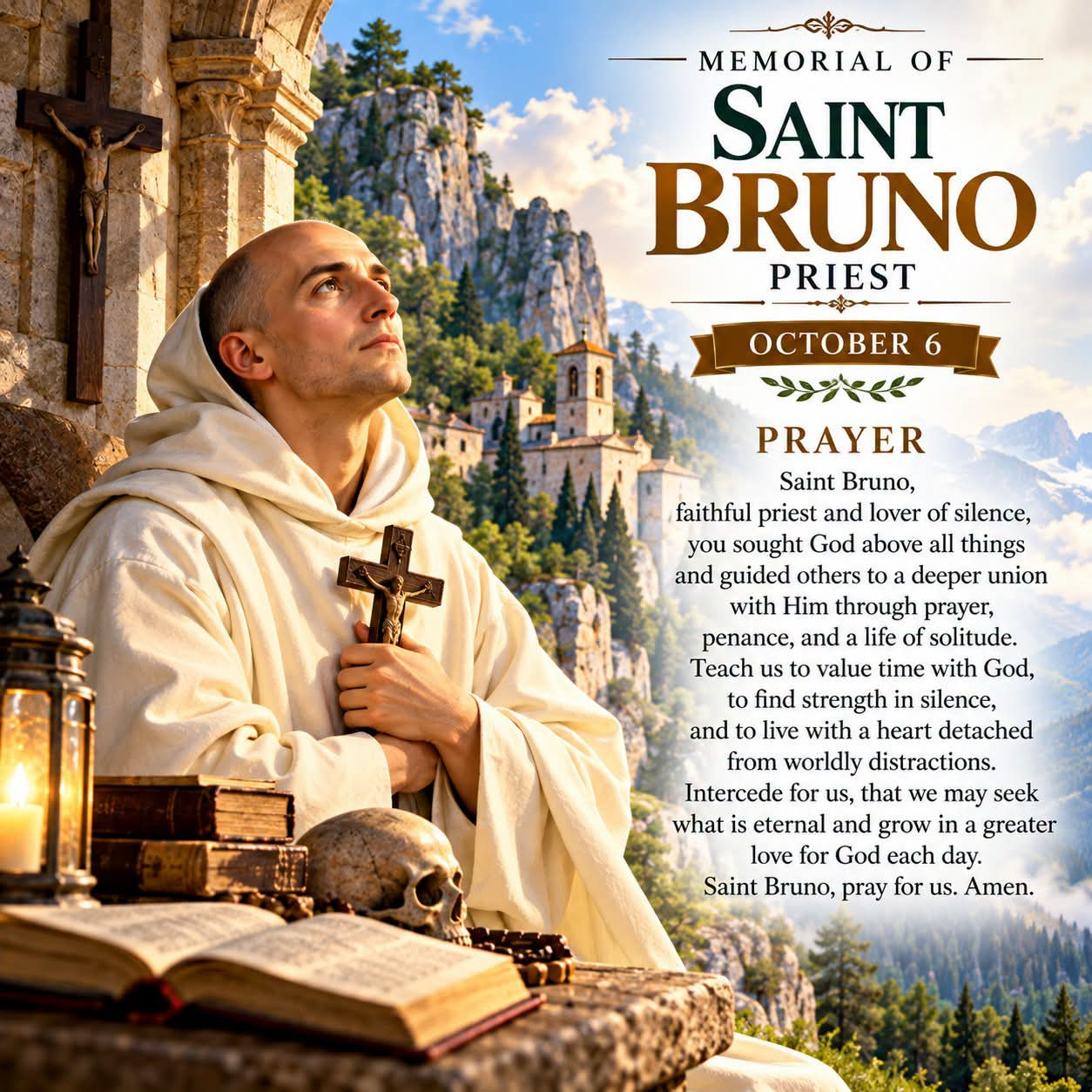
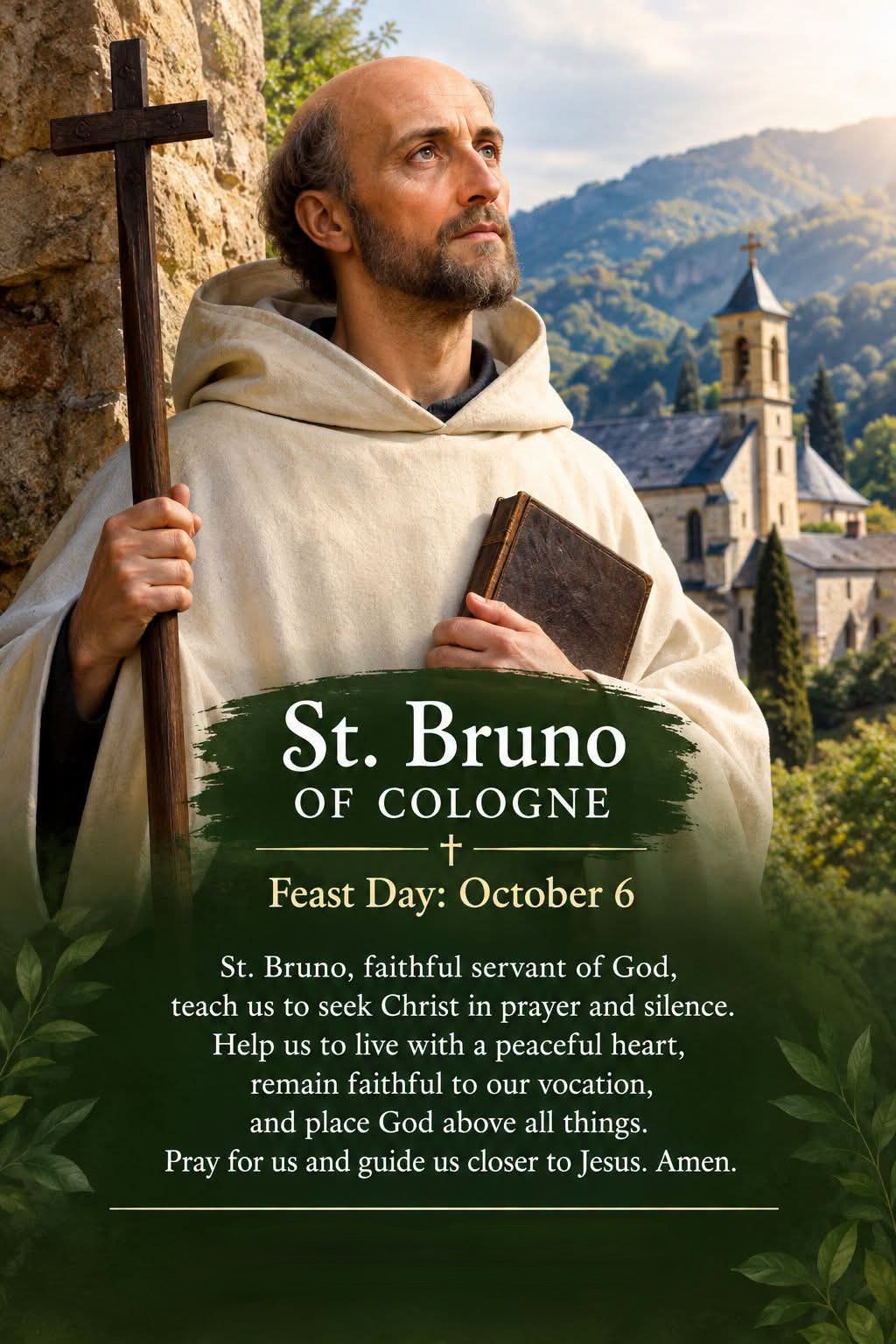
O Saint Bruno, master of wisdom and lover of silence, you chose the hidden path of solitude over the noise of honours and power.
Teach us to quiet our restless hearts, to discover God in stillness, and to live with integrity even when it is difficult.
Intercede for us that we may seek not glory but truth, not success but holiness, and like you, remain faithful in silence until God becomes our all in all. Amen

PRAYER
Saint Bruno, you wished to dedicate and consecrate your entire life to active and committed service to the Church but God had other plans for you, and you chose the better portion of seeking God in silence, poverty, study, and prayer.
Help all of us, mortal beings, to emulate your quiet dedication, focus, forbearance and patient endurance. Amen

Saint Bruno, pray for us all.