
TODAY’S GOSPEL READING – 9 OCTOBER
October 9, 2026
SAINT FRANCIS BORGIA, CONFESSOR – 10th OCTOBER
October 10, 2026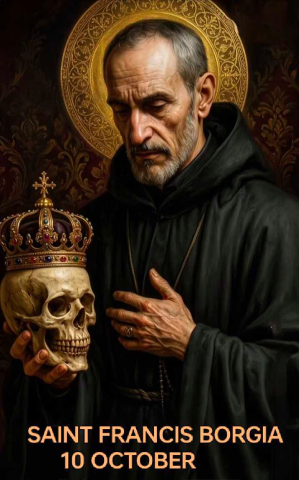
THE THINGS THAT PASS AWAY CAN AWAKEN US TO WHAT IS ETERNAL
The death of Empress Isabella became a turning point in Francis Borgia’s spiritual journey. He realised that beauty, prestige and earthly power could not prevent death. What once appeared permanent was suddenly revealed to be fragile.
“For what will it profit a man, if he gains the whole world and forfeits his life?”
— Matthew 16:26
As a nobleman at the Spanish court, Francis witnessed the death of the empress and was deeply affected by the transience of earthly glory. This experience awakened in him a desire to seek what endures eternally.
We, too, can become absorbed in achievements, possessions and recognition while neglecting our spiritual lives. Loss, illness and uncertainty can remind us that life is measured not by what we accumulate but by the love with which we live.
When the things that pass away lose their power to possess us, we become freer to seek the One who remains forever.
CONVERSION IS A JOURNEY OF REORDERING OUR PRIORITIES
Francis did not abandon his worldly responsibilities immediately after his spiritual awakening. He continued to serve at court, fulfil his duties and care for his family while gradually discerning God’s call.
“Seek first his kingdom and his righteousness.”
— Matthew 6:33
After his encounter with death, Francis continued to discharge his responsibilities as a nobleman. His conversion unfolded gradually until he recognised that God was calling him to a different way of life. Following his wife’s death, he eventually entered the Society of Jesus.
Conversion does not always require an immediate change of circumstances. It begins when we allow God to transform our intentions. We may continue working, leading and caring for others, but our motivation changes from personal advancement to loving service.
Conversion begins when God becomes the centre around which every other priority finds its proper place.
RESPONSIBILITY CAN BECOME A PATH TO HOLINESS
Francis was a husband and father before becoming a Jesuit priest. After his wife’s death, he made arrangements for his children’s future before embracing religious life. He understood that answering God’s call did not excuse him from fulfilling his responsibilities.
“Whoever is faithful in a very little is faithful also in much.”
— Luke 16:10
Francis’s care for his children demonstrated that his vocation had to be pursued with responsibility and love. His example teaches us that family duties, professional obligations and commitments to others can become opportunities for holiness.
Parents who sacrifice for their children, teachers who persevere with struggling students and leaders who make difficult but responsible decisions can all grow in holiness through faithful service.
God does not call us to holiness by ignoring our responsibilities, but by teaching us to fulfil them in love.
DETACHMENT MEANS FREEDOM, NOT CONTEMPT FOR THE WORLD
Francis relinquished his dukedom and embraced the poverty of religious life. He discovered that wealth, influence and social position could never provide the lasting fulfilment found in God.
“For where your treasure is, there your heart will be also.”
— Matthew 6:21
Although Francis had enjoyed the privileges of nobility, he eventually surrendered his title and possessions to follow Christ more completely. His decision demonstrated that earthly honours need not determine the direction of our lives.
Detachment does not necessarily mean having nothing. It means refusing to allow possessions, success or authority to control our hearts. Wealth can be used generously, leadership exercised humbly and success received gratefully when everything is placed at God’s service.
True detachment is the freedom to possess things without allowing them to possess the heart.
OUR GIFTS ARE MEANT TO BECOME INSTRUMENTS OF SERVICE
Francis acquired valuable administrative and leadership skills during his years at court. After entering the Society of Jesus, he placed these abilities at the service of the Church, supporting the formation of Jesuits, education and missionary work.
“As each has received a gift, employ it for one another, as good stewards of God’s varied grace.”
— 1 Peter 4:10
Francis did not abandon his natural abilities when he became a religious. Instead, he allowed God to redirect them towards spiritual and apostolic purposes. His experience in administration became valuable in his service as a Jesuit and eventually as Superior General.
Our professional experience, intellectual abilities and personal talents can also become instruments of God’s work. The important question is not merely what we can accomplish, but how our abilities can benefit others.
A gift reaches its deepest purpose when it is no longer used merely to elevate ourselves, but to serve God’s people.
GRIEF CAN BECOME A DOORWAY TO DEEPER SURRENDER
Francis was deeply affected by the death of Empress Isabella and later experienced the loss of his beloved wife. These experiences confronted him with the fragility of earthly life and helped deepen his spiritual discernment.
“The Lord is near to the brokenhearted, and saves the crushed in spirit.”
— Psalm 34:18
After his wife’s death, Francis gradually prepared to embrace religious life, making sure that his children’s needs were provided for. His journey shows how suffering can lead us to reconsider our priorities and seek a deeper relationship with God.
Grief is never easy, and the loss of someone we love can leave us wounded and uncertain. Yet, when we bring our sorrow honestly into prayer, we may discover a deeper trust in God’s presence. Francis’s later vocation did not diminish the importance of his marriage and fatherhood; those experiences helped shape the man who eventually served the Church.
Grief does not automatically lead us to God, but when brought honestly into prayer, it can become a place where deeper trust begins to grow.
LEADERSHIP IS A MINISTRY OF STEWARDSHIP
As Superior General of the Society of Jesus, Francis Borgia carried great responsibility for the formation of Jesuits and the development of their apostolic mission. He understood that leadership was a responsibility entrusted to him for the good of others.
“Whoever would be great among you must be your servant.”
— Matthew 20:26
During his leadership, Francis worked to strengthen the Society of Jesus, support its educational institutions and advance its missionary activities. His position was not merely an honour but an opportunity to serve the Church.
Christian leadership is not about possessing power or controlling others. It involves guiding people faithfully, encouraging their growth and ensuring that the mission remains true to its purpose. Leaders are called to exercise authority with humility, wisdom and compassion.
Authority becomes holy when it is exercised as stewardship rather than possession.
THE CROSS CAN PURIFY OUR AMBITIONS
Francis had experienced the honours and ambitions of court life. His encounter with death gradually led him to reconsider the purpose of his achievements and the direction of his life.
“And those who belong to Christ Jesus have crucified the flesh with its passions and desires.”
— Galatians 5:24
By surrendering his dukedom and embracing religious life, Francis demonstrated that following Christ sometimes requires relinquishing the ambitions that once defined us. He learned to direct his abilities towards a greater purpose than personal recognition.
The Cross challenges our desire for praise, exposes our attachment to comfort and reminds us that success is not the measure of our worth. It does not destroy every ambition but purifies it, teaching us to pursue worthwhile goals through love and service.
The Cross does not extinguish our gifts or aspirations; it purifies them so that they can serve a greater love.
THE GREATER THE RESPONSIBILITY, THE GREATER THE NEED FOR PRAYER
Francis Borgia’s leadership of the Jesuits required wisdom, discernment and decisions affecting communities and missions across many lands. Such responsibilities demanded a deep dependence on God.
“Apart from me you can do nothing.”
— John 15:5
As Superior General, Francis had to guide a growing religious order and help its members remain faithful to their mission. His life reminds us that responsibility must be accompanied by prayer, humility and a willingness to seek God’s wisdom.
Prayer helps us examine our motives, recognise our limitations and distinguish God’s will from our personal preferences. For Christian leaders, prayer is not an interruption to their work but an essential part of their service.
The more responsibility we carry, the more deeply we must learn to kneel before the One whose mission we serve.
THE GREATEST TITLE IS BELONGING TO CHRIST
Francis Borgia possessed titles and privileges that many people would have envied. Yet he eventually relinquished his dukedom and accepted the humble vocation of a Jesuit priest.
“For to me to live is Christ, and to die is gain.”
— Philippians 1:21
Francis’s decision to surrender his worldly position reflected his desire to belong more completely to Christ. He exchanged the prestige of nobility for a life of prayer, poverty and apostolic service.
We, too, may define ourselves by our professions, achievements, family backgrounds or social standing. Although these may be meaningful, they do not represent the deepest truth about us. Our fundamental dignity comes from being loved by God and called to follow Christ.
Titles change, responsibilities end and recognition fades. But a life rooted in Christ possesses a meaning that transcends earthly success.
The deepest dignity of a Christian is not found in the title the world gives, but in belonging to Christ and allowing His love to shape the whole of life.
HOLINESS IS NOT THE REJECTION OF GREATNESS BUT ITS TRANSFORMATION
Francis Borgia did not become holy simply by relinquishing his worldly influence. He became holy by allowing God to transform the purpose for which he used his abilities and authority.
“Whatever you do, work heartily, as serving the Lord and not men.”
— Colossians 3:23
Francis used his administrative experience and leadership abilities to strengthen the Society of Jesus, support education and advance missionary work. His gifts continued to bear fruit, but their purpose was no longer personal advancement.
His example teaches us that holiness does not always require abandoning positions of responsibility. It can also mean remaining in them while embracing humility, integrity and service. What matters is not how influential we become, but whether our influence brings goodness into the lives of others.
God can transform worldly greatness into spiritual fruitfulness when we surrender our gifts and ambitions to His service.
THE FINAL MEASURE OF LIFE IS LOVE
Francis Borgia’s life began amid the privileges of Spanish nobility and ended in devoted service to the Church. His journey included marriage, fatherhood, bereavement, conversion, priesthood and leadership.
“And above all these put on love, which binds everything together in perfect harmony.”
— Colossians 3:14
Through the different stages of his life, Francis gradually learned to direct his gifts and responsibilities towards God. His example invites us to examine not merely what we possess or achieve, but the kind of people we become.
Has power made us more generous? Has suffering made us more compassionate? Has knowledge made us wiser? Has leadership made us more responsible? Has success made us more grateful? Has prayer made us more loving?
The purpose of our spiritual journey is not simply to accumulate religious achievements but to become more deeply conformed to Christ through love, humility and faithful service.
At the end of life, the lasting question is not how much we possessed or achieved, but how faithfully we learned to love.
PRAYER THROUGH THE INTERCESSION OF ST. FRANCIS BORGIA
O God, who called St. Francis Borgia from worldly honour to a life of prayer and apostolic service, grant us the grace to seek You above every earthly ambition. Teach us to use our talents humbly, fulfil our family responsibilities faithfully and exercise authority for the good of others.
When success tempts us to pride, remind us of eternity. When duty becomes difficult, strengthen us in fidelity. When You call us to change, give us the courage to follow You wholeheartedly.
Through the intercession of St. Francis Borgia, may we grow in humility, detachment and love, using all that we have received for Your glory and the good of Your people. May our lives bring honour not to ourselves, but to Christ, our Lord and Saviour. Amen.
St. Francis Borgia, pray for us.