
TODAY’S GOSPEL READING – 10 APRIL
April 10, 2026
FEAST OF SAINT STANISLAUS OF KRAKOW, BISHOP AND MARTYR – 11th APRIL
April 11, 2026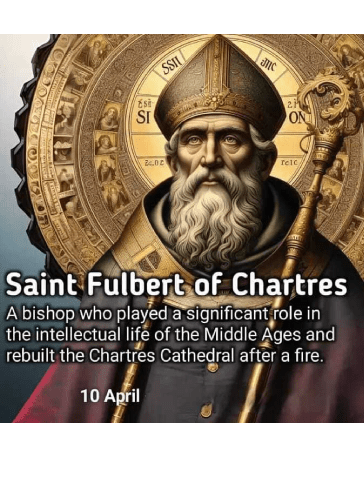
LIVING IN A TIME OF CULTURAL UNCERTAINTY
Fulbert lived during a period when Europe was emerging from disorder, and Christian learning was being rebuilt. As a teacher and later bishop, he became a steady guide in a time of confusion, helping people rediscover truth and stability through faith. His leadership at Chartres drew students from many regions, showing how God raises wise shepherds when the world is searching.
“If the foundations are destroyed, what can the righteous do?”
— Psalm 11:3
DEDICATION TO LEARNING AND TEACHING
Fulbert was deeply committed to study and teaching, seeing knowledge as a path to God. As head of the cathedral school at Chartres, he trained students not only in intellectual disciplines but also in virtue and faith. His teaching reflected the belief that reason and faith are not opposed but work together in harmony.
“Give instruction to a wise man, and he will be still wiser; teach a righteous man, and he will increase in learning.”
— Proverbs 9:9
FORMATION OF STUDENTS
Fulbert formed students with care, shaping both their minds and their character. Many who studied under him later became influential leaders in the Church and society. He emphasized discipline, humility, and a love for truth, ensuring that education led to transformation
“Train up a child in the way he should go; even when he is old he will not depart from it.”
— Proverbs 22:6
TRANSITION FROM TEACHER TO BISHOP
Though he loved teaching, Fulbert accepted the call to become Bishop of Chartres, embracing greater responsibility for the spiritual welfare of his people. This transition showed his willingness to serve wherever God called him, even when it meant leaving behind what was familiar.
“Each one should use whatever gift he has received to serve others.”
— 1 Peter 4:10
THE DESTRUCTION OF THE CATHEDRAL
A devastating fire destroyed the cathedral of Chartres during Fulbert’s time. This tragedy deeply affected the community, yet Fulbert responded with faith rather than despair. He reminded the people that their true foundation was in God, not merely in buildings.
“For no one can lay any foundation other than the one already laid, which is Jesus Christ.”
— 1 Corinthians 3:11
REBUILDING CHARTRES
Fulbert led the rebuilding of the cathedral with courage and vision. He organized resources, encouraged the faithful, and inspired hope in the midst of loss. The rebuilding became a symbol of spiritual renewal and trust in God’s providence.
“Those who hope in the Lord will renew their strength; they will soar on wings like eagles.”
— Isaiah 40:31
DEVOTION TO THE BLESSED VIRGIN MARY
Fulbert had a deep love for the Blessed Virgin Mary and promoted her devotion in Chartres. He contributed to the development of Marian theology and helped establish Chartres as a center of Marian devotion. His writings reflect a profound understanding of Mary’s role in salvation history.
“Behold, I am the handmaid of the Lord; let it be to me according to your word.”
— Luke 1:38
A LIFE OF LETTERS AND GUIDANCE
Fulbert was known for his letters, through which he offered guidance, correction, and encouragement to many. These writings reveal his pastoral heart and wisdom, as he supported both individuals and communities in their spiritual journeys.
“Let your speech always be gracious, seasoned with salt, so that you may know how you ought to answer each person.”
— Colossians 4:6
A QUIET BUT ENDURING LEGACY
Fulbert’s life was not marked by outward grandeur but by steady faithfulness. His influence endured through the school of Chartres, the rebuilt cathedral, and the lives he shaped. His legacy reminds us that true holiness often grows quietly yet bears lasting fruit.
“The righteous will flourish like a palm tree, they will grow like a cedar of Lebanon.”
— Psalm 92:12
PRAYER THROUGH THE INTERCESSION OF ST. FULBERT OF CHARTRES
Lord God,
who gave Saint Fulbert wisdom to teach and courage to rebuild,
grant us the grace
to seek truth with humility
and to live it with fidelity.
When we face loss, give us hope.
When we face confusion, give us clarity.
When we are called to lead, give us courage.
May all we learn and do
lead us closer to You.
Amen