
SPIRITUAL INSIGHTS INTO THE LIFE OF SAINT GILES
September 1, 2026
Matthew 6:34
September 2, 2026
FEAST OF BLESSED JOHN FRANCIS BURTÉ AND COMPANIONS, MARTYRS
FEAST DAY – 2nd SEPTEMBER
Blessed John Burte (Died 1792) was one among as many as 191 Bishops, Priests, Religious and other secular victims, martyred during the French Revolution. Their deaths became known as the September Carmelite Massacre of 1792. All were imprisoned in a Church attached to a Carmelite Monastery in Paris for refusing to disown their faith and take an oath of allegiance to the de-Christianizing Revolution.
Practically every page in the history of the French Revolution is stained with blood. The Carmelite Massacre of 1792, added nearly 200 victims to this noble company of martyrs. They were all priests, secular and religious, who refused to take the schismatic oath and had been imprisoned in the church attached to the Carmelite monastery in Paris. Among these priests were a Conventual, a Capuchin, and a member of the Third Order Regular. These priests were victims of the French Revolution.
Though their martyrdom spans a period of several years, they stand together in the Church’s memory because they all gave their lives for the same principle. The Civil Constitution of the Clergy (1791) required all priests to take an oath which amounted to a denial of the faith. Each of these men refused and was executed.
John Francis Burte was born in the town of Rambervillers in Lorraine. At the age of 16, he joined the Franciscans at Nancy and there he also pronounced his solemn vows. In due time he has ordained a priest and for some time taught theology to the younger members of the order. He was at one time also superior of his convent.
After Pope Clement XIV, formerly a Conventual friar had ordered the merging of the province of the Franciscans, to which John Francis belonged, with the Conventuals, Father John Francis was placed in charge of the large convent in Paris and encouraged his brethren to practice the strict observance of the rule. His zeal for souls was outstanding, and he zealously guarded the rights of the Church in this troubled period of history.
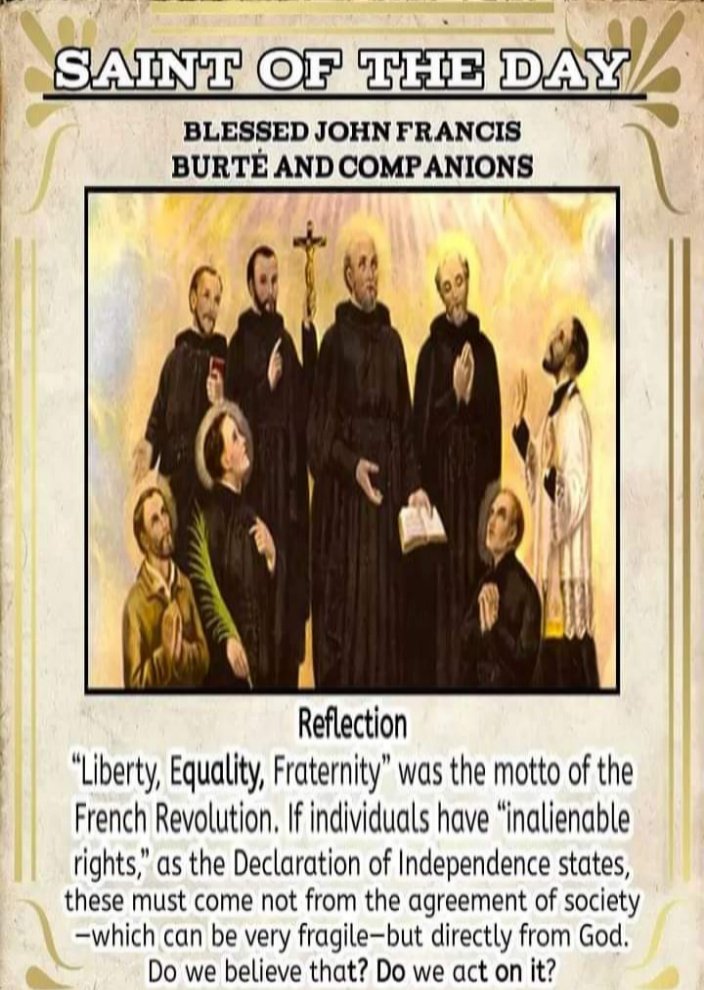
When the French Revolution broke out, he was reported for permitting his priests to exercise their functions after they refused to take the infamous oath required by the government, and which was a virtual denial of their Faith. He was arrested and held captive with other priests in the convent of the Carmelites. His constancy in refusing to take the sacrilegious oath won for him a cruel martyrdom on September 2, 1792.
Acquiring a reputation as an excellent preacher, confessor, and instructor of clerics, Apollinaris of Posat was preparing to go East as a missionary. He was in Paris studying Oriental languages when the French Revolution began. Refusing the oath, he was swiftly arrested and detained in the Carmelite convent.
Born John James Morel before his entrance into religion, he was born near Fribourg in Switzerland in 1739 and received his education from the Jesuits. In 1762 he joined the Capuchins in Zug and before long became a prominent preacher, a much-sought confessor, and an eminent instructor of the young clerics of the order. He impressed on their minds the truth that piety and learning are the two eyes of a priest, and humility was a dominating virtue in his life. He suffered a cruel martyrdom on September 2, 1792.
Severin Girault, a member of the Third Order Regular, was a chaplain for a group of sisters in Paris. Imprisoned with the others, he was the first to die in the slaughter at the convent, a priest of the Third Order Regular, formerly George Girault, his undaunted courage merited the grace to be numbered among these martyrs of Christ.
He was born at Rouen in Normandy, and early in life joined the Third Order Regular of St. Francis. Because of his eminent mental gifts, he was chosen a superior of his order. In the exercise of his priestly duties, he displayed a marked zeal for souls, and as chaplain of the convent of St. Elizabeth in Paris, he was a prudent director in the ways of religious perfection.
He was also summoned to take the civil oath, and upon his refusal to do this he was seized and confined in the Carmelite convent where so many other confessors of Christ were being detained. On September 2, while he was saying his Office in the convent garden, the raving assassins made him the first victim of their cruel slaughter.
These three members of the Franciscan Order, together with 182 other servants of God who suffered martyrdom at this time, were solemnly beatified by Pope Pius XI, and the Franciscan Order was granted permission to celebrate their feast annually with an Office and special Mass.
These three plus 182 others—including several bishops and many religious and diocesan priests—were massacred at the Carmelite house in Paris on September 2, 1792. They were beatified in 1926, John Baptist Triquerie, born in 1737, entered the Conventual Franciscans. He was chaplain and confessor of Poor Clare monasteries in three cities before he was arrested for refusing to take the oath. He and 13 diocesan priests were guillotined in Laval on January 21, 1794. He was beatified in 1955.
“Liberty, Equality, Fraternity” was the motto of the French Revolution. If individuals have “inalienable rights,” as the Declaration of Independence states, these must come not from the agreement of society (which can be very fragile/ mutable/ mercurial/ fickle/ ephemeral/ illusory) but directly from God, which the Declaration also declares with certitude and religious conviction to be the case for the United States. At least we started out that way.
“The upheaval which occurred in France toward the close of the 18th century wrought havoc in all things sacred and profane and vented its fury against the Church and her ministers. Unscrupulous men came to power who concealed their hatred for the Church under the deceptive guise of philosophy…. It seemed that the times of the early persecutions had returned. The Church, a spotless bride of Christ, became resplendent with bright new crowns of martyrdom” (Acts of Martyrdom).
PRAYER
Bl. John Francis Burte, you and your companions of martyrs stood staunchly and faithfully defending the Faith, in the face of inevitable death. You all proved yourselves loyal followers of Christ, worthy of the crown of martyrdom.
Pray for us that we will remain loyal to our faith and share it with our community and touch as many hearts as we can. Amen

*********************************
ALSO CELEBRATED:
SAINT WILLIAM OF ROSKILDE
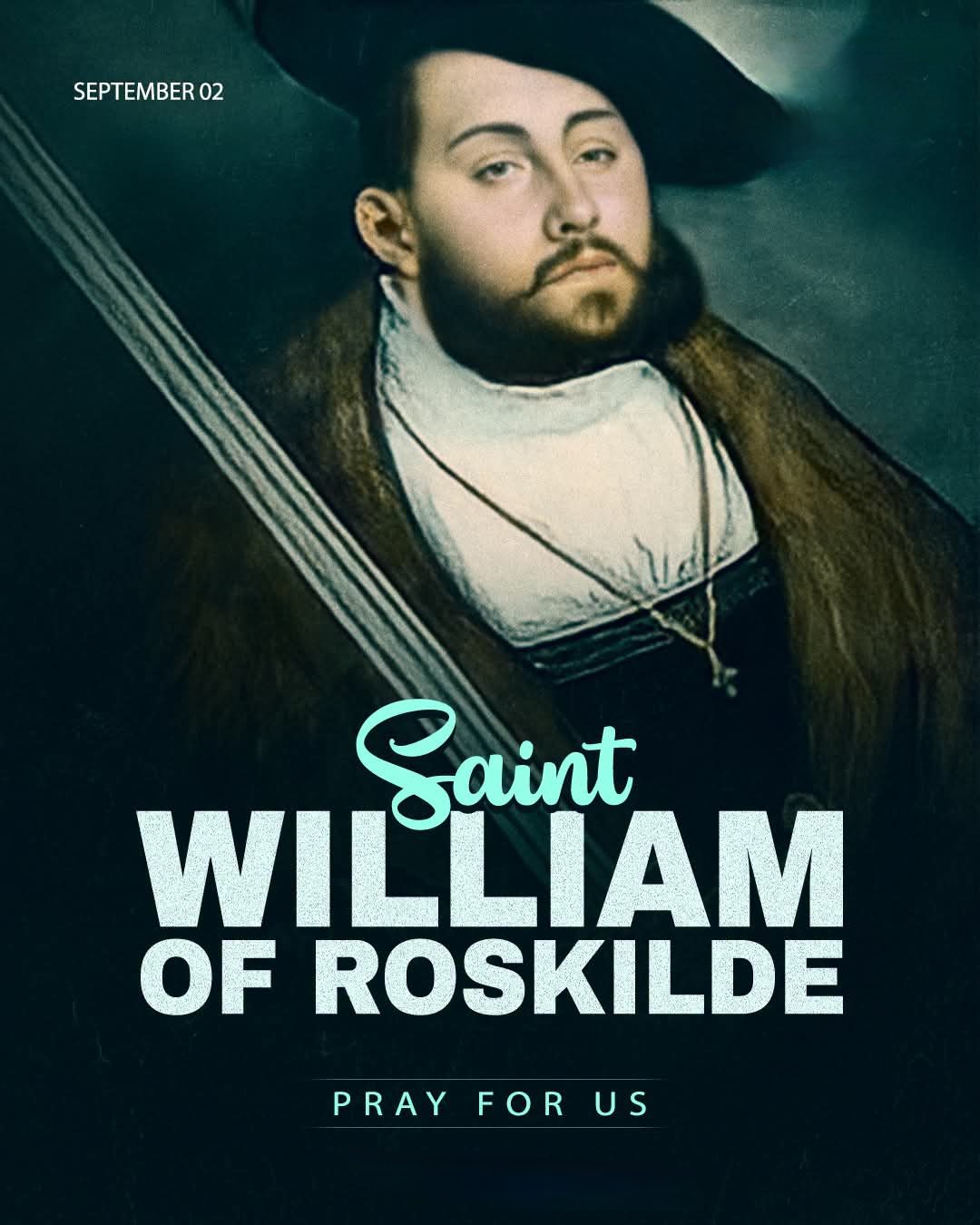
St. William of Roskilde was an English priest who was chaplain to King Scanute. The zealous servant of God was traveling with the King on one of His Majesty’s trips from England to Denmark when he saw the ignorance, idolatry, and superstition that so many Danes lived in and was so moved by compassion that he decided to stay behind and preach Christ and his Gospel. Later, he was promoted to the Episcopal see of Roskilde in Zealand. The majority of William’s affairs revolve around his tireless efforts to change King Sweyn Estridsen’s behavior.
St. William confronted Sweyn after he had once executed some of his subjects not only without a trial but also inside a church. True to his name, William—whose name means “Strong Helmet”—held out his pastoral staff and forbade Sweyn from entering the house of God until his hands were free of the blood he had wrongfully shed.
He offered his neck, declaring that he was prepared to die in defense of the Church of God, as he saw some of the courtiers agitatedly draw their swords. Sweyn thereupon made a public admission of guilt and later offered some land as a peace gift to the church of Roskilde.
William and Sweyn had great affection for each other, and for some years the saint and the penitent concurred to promote the cause of religion. King Sweyn died in 1070, and St. William died a few days later while waiting outside the church to receive the King’s body. They were buried together at Roskilde.
CONTEMPLATING THE LIFE OF SAINT WILLIAM OF ROSKILDE
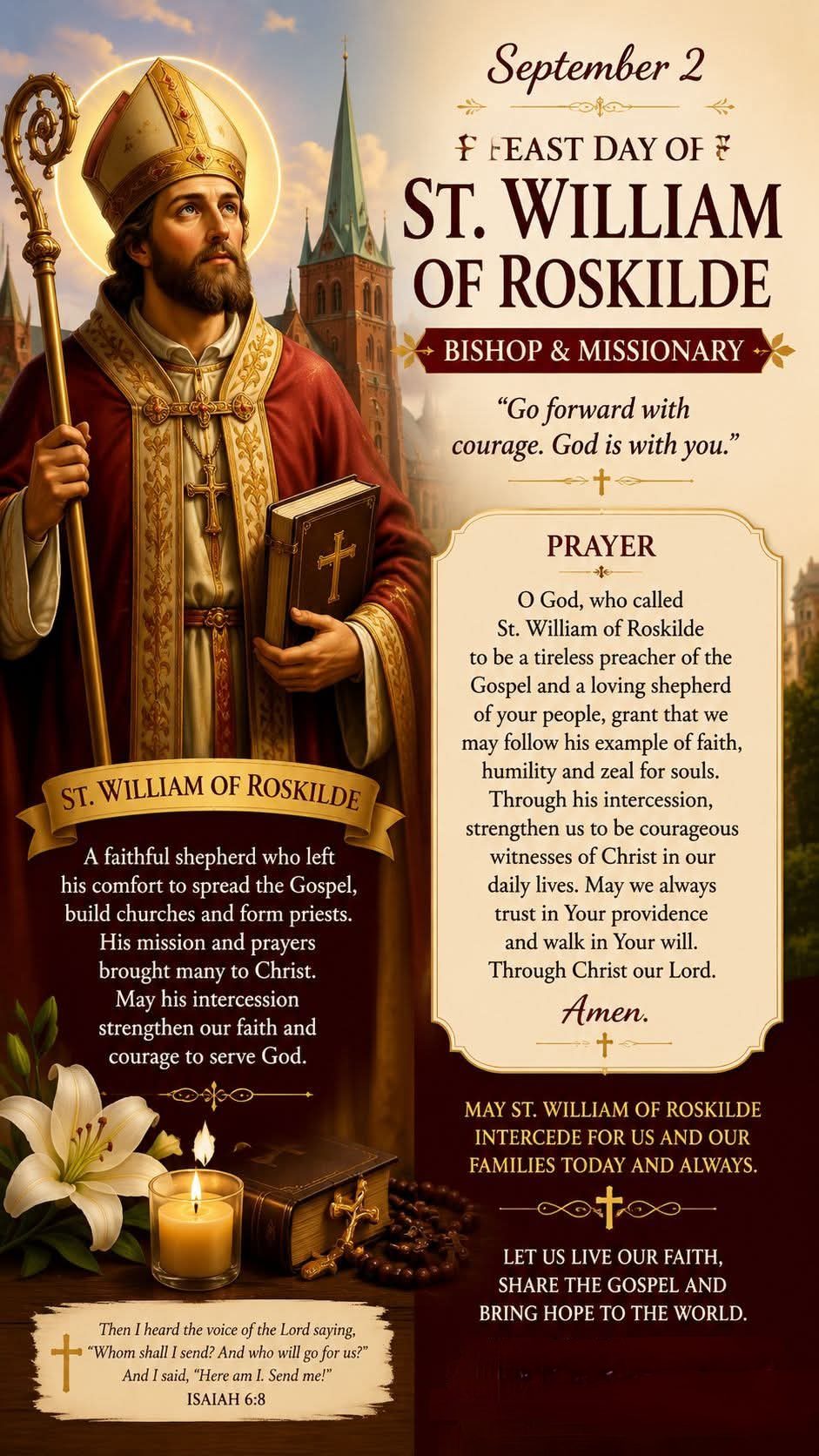
BISHOP OF ROSKILDE, MISSIONARY TO DENMARK, AND PEACEMAKER
Saint William of Roskilde, also known in some traditions as William of Æbelholt or William of Denmark, was an eleventh century Churchman associated with the Christianization of Denmark. He is remembered as a priest, bishop, reformer, peacemaker and courageous defender of Church discipline and truth.
His feast is traditionally celebrated on 2 September. Probably born in England in the early eleventh century, he eventually made Denmark his home and served as Bishop of Roskilde. His life was marked by missionary work, the reform of clergy, the defence of Church rights, reconciliation and the courage to speak truth even before Danish royalty.
THE MAN WHO CROSSED THE SEA
England was William’s homeland, with its familiar churches, people and language. Yet a call came from across the sea. Denmark needed priests, for Christianity was taking root while pagan customs still remained. The Church needed stronger foundations, priests needed formation and Christian life needed to become deeply rooted.
William could have remained where life was familiar, but he chose to follow God’s call. He crossed the sea and became a missionary among people he did not yet know. His journey teaches us that God’s call often takes us beyond what is comfortable and familiar.
A CHURCH STILL LEARNING TO BECOME CHRISTIAN
William arrived in a land undergoing a profound spiritual transformation. People were learning to pray in a new way, old customs were gradually giving way to the Gospel and churches were being established.
Yet William understood that conversion was more than receiving Baptism or building churches. It involved transforming marriages, families, morality, leadership, worship, justice and everyday life. He patiently worked to build not merely Christian institutions, but a genuinely Christian people.
THE PRIEST WHO BECAME A BISHOP
William was eventually chosen as Bishop of Roskilde. His responsibility now extended far beyond his own spiritual life. He was called to shepherd others, form priests, correct abuses, strengthen the Church and defend its spiritual mission.
His ministry also brought him into contact with kings and political authority. This would become one of the greatest tests of his courage and fidelity.
THE BISHOP WHO HAD A KING AS A FRIEND
William became close to King Sweyn II, who respected him. William could have used this friendship to gain comfort, influence or personal advantage. Instead, he used it as an opportunity to speak the truth.
He understood that genuine friendship sometimes requires correction. He did not want to be a bishop who simply approved everything the king did. He desired to be a faithful conscience and a servant of truth.
WHEN TRUTH BECAME DANGEROUS
During the reign of King Canute IV, tensions increased as the king pursued ambitious policies and military campaigns. William watched carefully, prayed and eventually confronted the king.
He challenged and rebuked him despite knowing that the king possessed the power to punish him. William understood that his calling required courage. He would not remain silent merely because the person who needed correction wore a crown.
THE COURAGE TO STAND BEFORE POWER
William stood before royal power not as a political rival, but as a shepherd and servant of Christ. The king possessed armies and earthly authority, while William possessed no army except the strength of his faith and the authority entrusted to him by God.
He was not seeking conflict. He was seeking righteousness. His courage demonstrates that one person who faithfully speaks the truth can possess a strength greater than worldly power.
WHEN THE CROWN AND THE CROSS COLLIDED
The political situation eventually deteriorated, and King Canute was killed in 1086 at the church of Saint Alban in Odense. William became involved in the aftermath.
At such a moment, revenge could easily have been mistaken for justice. Yet William sought reconciliation and peace. He understood that genuine peace does not come from ignoring wounds or denying wrongdoing. It requires truth, repentance, forgiveness and restoration.
THE BISHOP WHO UNDERSTOOD REAL PEACE
William’s life helps us distinguish between false peace and Christian peace.
False peace avoids difficult truths, ignores problems and allows injustice to continue simply to preserve outward comfort.
Christian peace speaks the truth, corrects what is wrong, forgives those who have caused harm and seeks to rebuild what has been broken.
William pursued this deeper peace. He understood that peace without truth is fragile, while truth without love can become destructive. Christian discipleship requires both truth and love.
BUILDING MORE THAN CHURCHES
William’s ministry was not limited to dramatic encounters with kings. Much of his work was quiet and faithful. He formed priests, strengthened Christian communities, promoted discipline, encouraged worship and helped establish a stronger Church.
He was building something that would continue beyond his own lifetime. The greatest achievement of a bishop is not always what people remember about him, but what continues because he served faithfully.
THE MISSIONARY WHO BECAME DANISH
William crossed the sea as a foreign missionary, but Denmark gradually became his home. He arrived as an outsider and eventually became a shepherd of the Danish Church.
He devoted his life to people who were not originally his own. His story reveals a beautiful truth about Christian mission: genuine love gradually removes the barriers between stranger and neighbour.
THE FINAL YEARS
After many years of preaching, teaching, correcting, defending, reconciling, building and serving, William’s earthly pilgrimage came to an end.
Around 1075, he died after a lifetime dedicated to the service of God and His people. The man who had once crossed the sea was now ready to cross another boundary, from earthly life into eternity.
THE BISHOP WHO CHOSE THE CROSS OVER THE CROWN
William’s life can be understood through the contrast between the crown and the Cross. The crown represented earthly authority and demanded obedience, while the Cross called him to truth, fidelity and sacrifice.
William chose the Cross. His first loyalty was not to a king, political power, popularity or even his own safety. His first loyalty was to Christ.
Because he belonged to Christ, he could serve kings without becoming their servant. His courage came from knowing that God’s authority was greater than every earthly authority.
WHY SAINT WILLIAM OF ROSKILDE MATTERS
William’s significance lies not simply in spectacular events, but in the kind of Christian leadership he embodied.
He was a missionary who left his homeland to serve another people.
He was a bishop who accepted responsibility for an emerging Church.
He was a reformer who sought greater holiness and discipline.
He was a peacemaker who worked for reconciliation amid political conflict.
He was a courageous truth teller who was willing to confront powerful people.
He was a servant who spent his life building up the Church rather than himself.
His life brings together faith, courage, truth, leadership and mercy. Saint William teaches us that Christian leadership is not merely about making people comfortable or pleasing everyone. It is about helping people become holy.
Sometimes that requires the courage to speak the truth when nobody else is willing to hear it.
PRAYER
St. William of Roskilde, pray for us that we will find true joy in living the Gospel amidst the trials.