
TODAY’S GOSPEL READING – 1 SEPTEMBER
September 1, 2026
FEAST OF BL. JOHN FRANCIS BURTÉ & COMPANIONS, MARTYRS – 2nd SEPTEMBER
September 2, 2026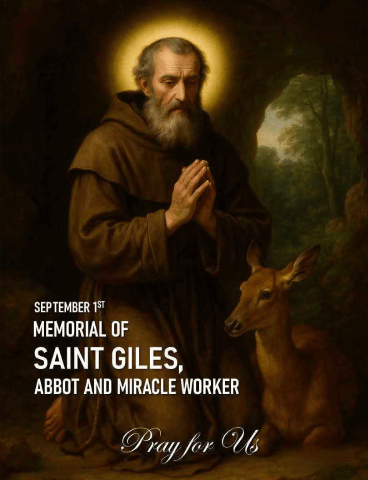
GOD MAY ASK US TO LEAVE WHAT WE POSSESS IN ORDER TO DISCOVER WHAT POSSESSES US
“Do not store up for yourselves treasures on earth… but store up for yourselves treasures in heaven.”
— Matthew 6:19–20
According to tradition, Saint Giles gave away his inheritance and chose a life of simplicity and prayer. He understood that earthly possessions can quietly become chains when they take the place of God. By letting go of what he owned, he discovered the freedom of belonging completely to Christ. True freedom begins when God becomes our greatest treasure.
SOLITUDE IS MEANT TO MAKE US MORE LOVING
“Come away to a deserted place all by yourselves and rest a while.”
— Mark 6:31
Saint Giles withdrew into the wilderness to seek God in prayer and solitude. Yet his solitude did not make him indifferent to others. People eventually came to him for guidance, prayer and help, and his hidden life became a source of blessing to many. Time spent with God should make our hearts more compassionate, patient, forgiving and ready to serve.
SOMETIMES GOD SENDS THE WOUNDED TO OUR DOOR
“God is our refuge and strength, a very present help in trouble.”
— Psalm 46:1
One of the best known traditions about Saint Giles tells how a wounded and frightened hind fled from hunters and found protection with him. Giles sheltered the animal and cared for it, even though doing so exposed him to danger. Like that frightened creature, people may come to us carrying fear, loneliness or pain. Our first response may simply be to become a safe and compassionate presence.
LOVE PLACES ITSELF BETWEEN THE VULNERABLE AND THE THREAT
“Greater love has no one than this, to lay down one’s life for one’s friends.”
— John 15:13
The traditional story says that Giles protected the hind from hunters and was struck by an arrow intended for the animal. His willingness to suffer rather than abandon a vulnerable creature reflects the protective love at the heart of Christian discipleship. Whenever we defend someone who is weak, rejected, bullied or forgotten, we imitate the selfless love of Christ.
OUR WOUNDS CAN BECOME PLACES OF MINISTRY
“LHe heals the brokenhearted, and binds up their wounds.”
— Psalm 147:3
The arrow wound traditionally associated with Saint Giles remained part of his story and became a reminder of his compassion and courage. His suffering did not prevent him from serving God; it became part of his witness. Our own wounds can also teach us compassion. What once caused us to ask why we were suffering may eventually help us understand and comfort another person who is hurting.
GOD CAN INTERRUPT EVEN OUR HOLIEST PLANS
“My thoughts are not your thoughts, nor are your ways my ways, says the Lord.”
— Isaiah 55:8
Saint Giles desired a hidden life as a hermit, but his reputation for holiness gradually drew others to him. According to tradition, disciples gathered around him and he eventually became the spiritual father of a community. God transformed his desire for solitude into a wider mission. Even good plans must be surrendered to God, because His purpose may be greater than what we originally imagined.
HIDDENNESS IS NOT USELESSNESS
“Your Father who sees in secret will reward you.”
— Matthew 6:4
Saint Giles lived much of his life away from the centres of power and recognition. Yet his prayer, simplicity and faithfulness eventually influenced many people, and his name became associated with places of prayer and service throughout Europe. God often does His deepest work in hidden places. A prayer offered secretly, an unnoticed act of kindness or faithful service may have an impact far beyond what we can see.
THE WEAK OFTEN RECOGNIZE A SAFE HEART
“The Lord is a refuge for the oppressed, a stronghold in times of trouble.”
— Psalm 9:9
The traditional account of the hind seeking refuge with Giles beautifully portrays the gentleness of his character. The frightened animal found safety in his presence. Saint Giles reminds us that holiness should never make others feel threatened or insignificant. A Christ like heart creates room for the frightened, the wounded and the vulnerable to regain their dignity and peace.
GOD CAN TURN OUR ESCAPE INTO OUR MISSION
“Let us then pursue what makes for peace and for mutual upbuilding.”
— Romans 14:19
Saint Giles withdrew from worldly distractions because he desired to give himself completely to God. Yet the people he had sought to leave behind eventually came looking for him. His wilderness became a place where others encountered prayer, wisdom and compassion. Sometimes God gives us periods of solitude not simply to withdraw from others, but to prepare us to return to them carrying His peace.
THE GREATEST REFUGE IS GOD HIMSELF
“The Lord is my rock, my fortress and my deliverer, my God, my rock in whom I take refuge.”
— Psalm 18:2
Saint Giles became known as a protector and refuge for those who came to him, but his own strength came from God. His life of prayer and dependence upon the Lord enabled him to become a source of comfort to others. We can become a refuge for those who suffer only when our own hearts are rooted in God. He alone is the deepest and unfailing refuge.
PRAYER THROUGH THE INTERCESSION OF ST. GILES
O Saint Giles, humble hermit, lover of solitude, protector of the vulnerable and faithful servant of God, you left behind worldly possessions to seek the treasure of Christ. When the frightened and wounded came to you, you became a refuge for them.
Pray for us and free our hearts from everything that possesses us more than God. Teach us to seek silence so that we may hear the Lord more clearly and become more loving toward others.
When the vulnerable come before us, give us compassionate hearts. When others are afraid, make us places of safety. When we see someone being wounded, give us the courage to stand beside them.
When our own wounds cause us pain, help us trust that God can transform suffering into compassion and grace. Teach us to surrender our plans to God’s will, to remain humble when honoured, and to serve faithfully even when no one notices.
May our lives become a refuge for the frightened, a shelter for the wounded and a pathway leading others toward the true Refuge, Jesus Christ our Lord.
Through Christ our Lord. Amen.
Saint Giles, humble hermit, protector of the weak, refuge of the afflicted and faithful servant of God, pray for us.