
SPIRITUAL INSIGHTS INTO THE LIFE OF ST. WILLIAM OF MONTEVERGINE
June 25, 2026
Colossians 3:2
June 26, 2026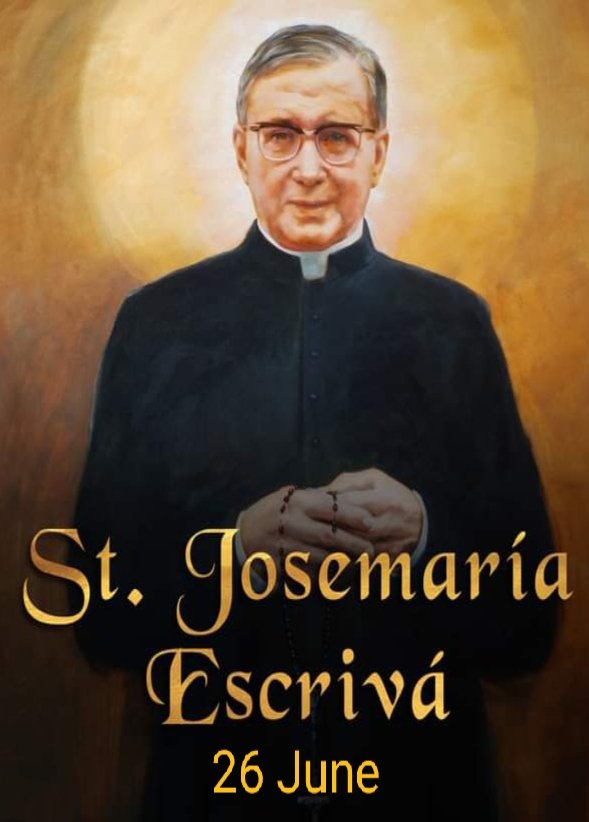
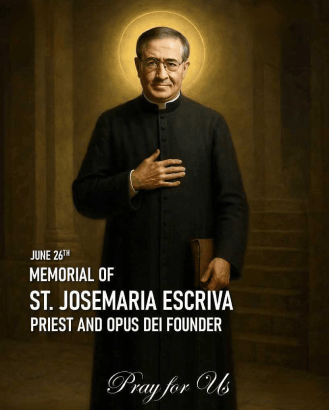
FEAST OF SAINT JOSEMARIA ESCRIVA, PRIEST
FEAST DAY – 26 JUNE
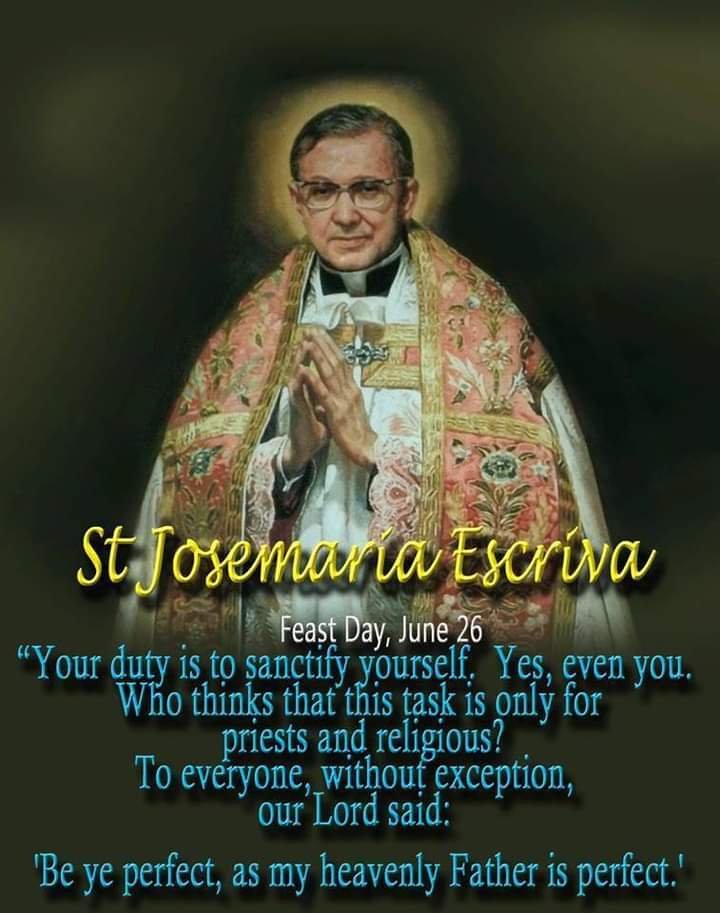
One of six children born to Jose and Dolores Escriva; three of Josemaria’s siblings died in infancy. His father was a small businessman, and when his business failed in 1915, the family moved to Logroño, Spain. As a young man, Josemaria saw the bare footprints left in the snow by a monk; the sight moved him, and kindled a desire for religious vocation. He studied for the priesthood in Logroño and Zaragoza, Spain. His father died in 1924, and Josemaria had to simultaneously support the family while studying. Ordained in Zaragoza on 28 March 1925.
As a young priest, he was a rather well-known speaker in Madrid, Spain. Besides being an excellent homilist, he also preached retreats, gave parish missions, and taught classes. A young woman heard that Father Josemaria was scheduled to give some lectures nearby and, in light of his reputation, was eager to hear him. But first she went to one of his Masses. After that, the woman had no interest in hearing him lecture; instead she wanted to discover God’s will for her life.
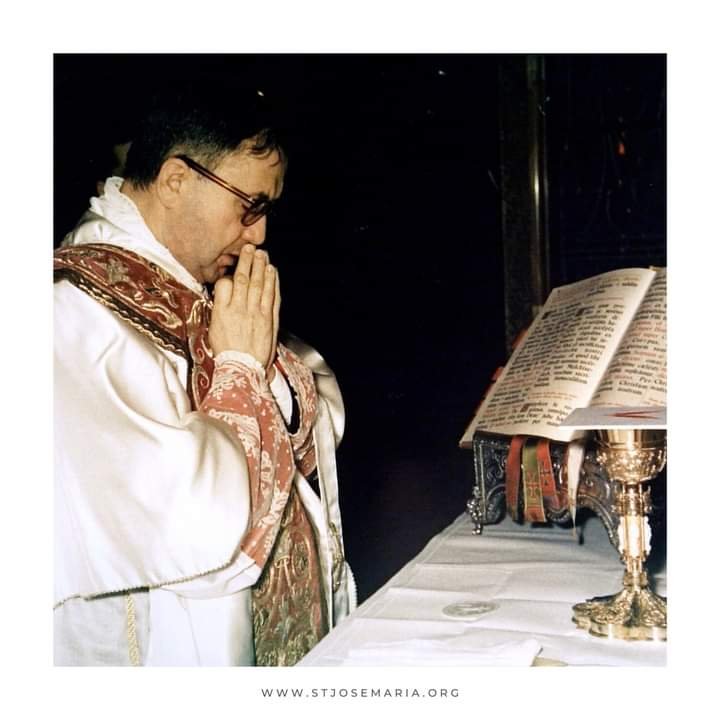
Saint Josemaria’s example of intense devotion and prayerfulness in saying Mass made her rethink her entire vocation. A good priest disappears into his vocation, submerges himself in Christ, and communicates a divine, not a personal, message. He makes people think of God, not him. At Mass the priest is not himself, yet is fully himself. He performs a sacrament because he is a sacrament. The Sacrament of Holy Orders is hidden behind the aspects of a man, the Holy Eucharist under the aspects of bread and wine.
It is the theology of the Church that every sacrament validly performed is efficacious, that it transmits sanctifying grace to the soul. But the fruitfulness of a sacrament for its recipient, either psychologically or spiritually, fluctuates. It can hinge on any number of factors, from the beauty of a Church, the quality of a homily, the sacredness of the music, or the intellectual preparation and ardor of the one receiving the sacrament.
A holy, charitable, and educated priest infuses every sacrament he celebrates with a theological meaning that yields spiritual fruit that goes beyond efficaciousness. Saint Josemaria’s writings, preaching, lectures, and talks were so rich, so chock-full of practical purpose and high meaning, that a great international family gathered around him, harvesting from his sustained example and insights an abundant banquet for their spiritual table.
Josemaria Escriva was born in a small town in rural Spain. He attended diocesan seminaries in the nearby city of Zaragoza and was ordained a priest in 1925. In 1928 he experienced a vision which spurred him to found Opus Dei, an institution that quickly spread to all the major Christian countries. Opus Dei consists primarily of married lay men and women, while some members are unmarried and consecrated celibates. A few members are priests.
After two thousand years of Catholic spirituality, it might be asked what new insight warranted the foundation of a new Church institution? It is a sign of the Church’s theological and spiritual fecundity that Saint Josemaria did offer a new, innovative approach to living as a disciple of Christ nineteen hundred years after Christ returned to the Father.
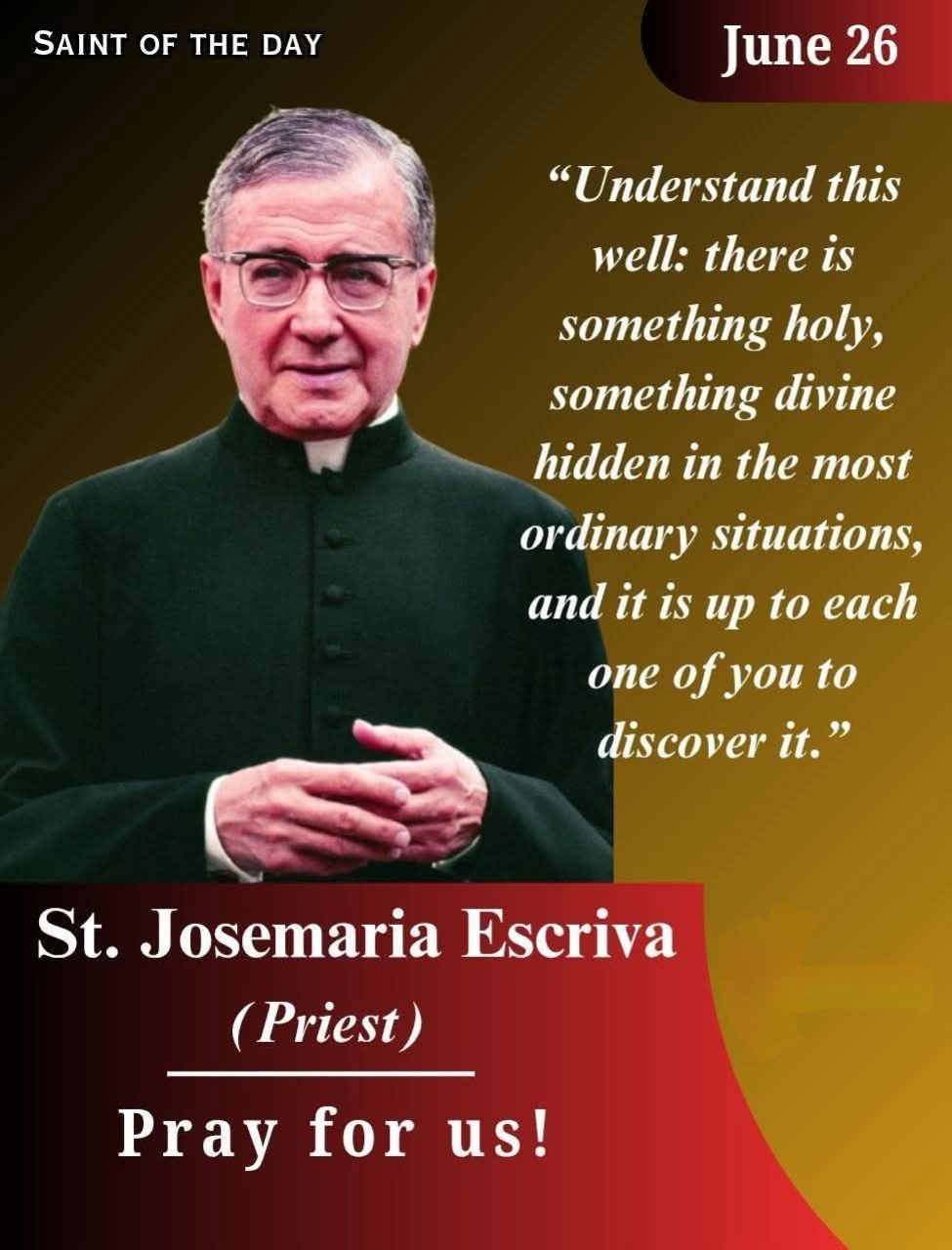
In a homily from 1967, Josemaria states his spirituality in clear terms: “…God is calling you to serve Him ‘in and from’ the ordinary, material, and secular activities of human life. He waits for us every day in the laboratory, in the operating room, in the army barracks, in the university, in the factory, in the workshop, in the fields, in the home and in the immense panorama of work. Understand this well: there is something holy, something divine hidden in the most ordinary situations, and it is up to each one of you to discover it.”
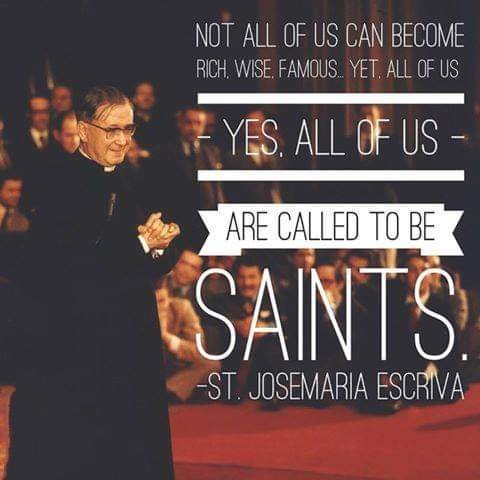
In other words, there is no need for a serious lay Catholic to abandon his work and routine, his family life, or his everyday relationships to fulfill God’s will. God is found in and through ordinary life. Cardinal Albino Luciani, later Pope John Paul I, perceptively noted that Saint Josemaria was not teaching a ‘spirituality for lay people,’ as Francis de Sales taught, but a ‘lay spirituality.’
It is not a question of praying the rosary while sweeping the floor, or contemplating scripture while driving. It is about “materializing” holiness by converting ordinary, well-done work into a sacrifice and prayer to God. Ordinary work, then, is not just the context, but the raw material, for lay holiness. All jobs are important. Daily life is not a distraction from God’s will for us. Daily life is God’s will for us. When we get to work we get to God.
He was born on 9 January 1902 at Barbastro, Spain. He died on 26 June 1975 of natural causes in his office in Rome, Italy. He was interred at Prelatic Church of Our Lady of Peace at Viale Bruno Buozzi 75, Rome, Italy and beatified on 17 May 1992 by Pope John Paul II.

The beatification miracle involved the cure in 1976 of Carmelite Sister Concepcion Boullon Rubio from the nearly-fatal cancerous form of lipomatosis following prayers by her family for the intercession of Father Josemaria. He was canonized on 6 October 2002 by Pope John Paul II. The canonization miracle involved saving a surgeon’s hands from a career-ending disease.
CONTEMPLATING THE LIFE OF SAINT JOSEMARÍA ESCRIVÁ DE BALAGUER
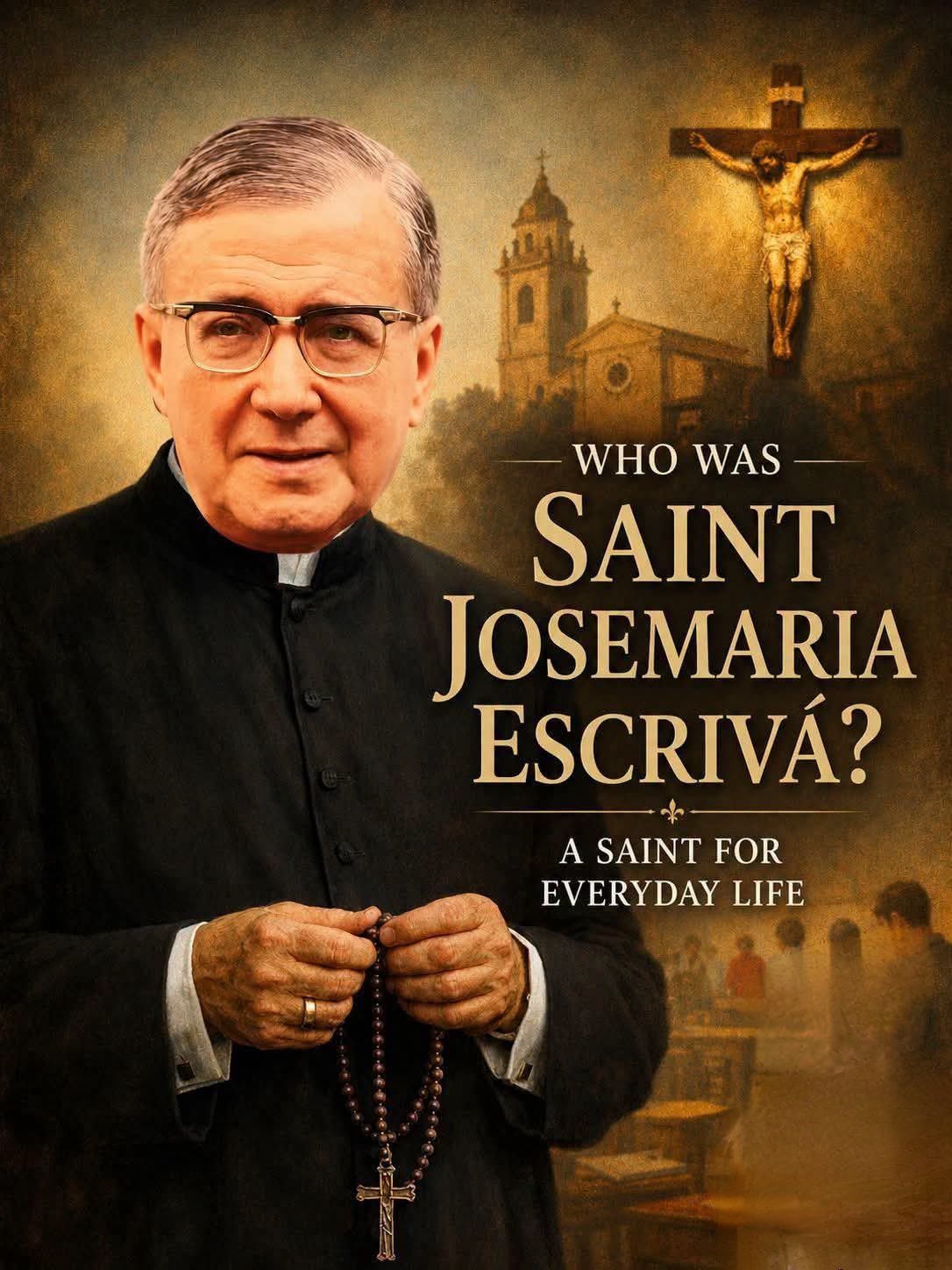
THE SAINT WHO TAUGHT THAT ORDINARY LIFE CAN LEAD TO HOLINESS
St. Josemaría Escrivá de Balaguer was one of the most influential Catholic saints of the twentieth century. He founded Opus Dei and proclaimed a timeless truth that every baptized Christian is called to holiness. He taught that sainthood is not reserved for priests and religious alone but is attainable by parents, teachers, doctors, workers, students, businesspeople, homemakers, and all who faithfully carry out their daily duties. Ordinary work, family life, and everyday responsibilities can become a path to union with God.
THE SAINT WHO FOUND GOD IN ORDINARY LIFE
A CHILD FORMED BY JOY AND SORROW
Born in Barbastro, Spain, in 1902, Josemaría was raised in a devout Catholic family where faith was lived by example. The early deaths of several of his siblings and the hardships his family endured taught him that earthly life is fragile and that lasting hope is found in God. These experiences quietly prepared him for his future mission.
FOOTPRINTS IN THE SNOW
As a teenager, Josemaría saw the barefoot footprints of a Carmelite friar in the snow. Deeply moved by this act of sacrifice, he asked himself what he was offering to God. That moment awakened within him a desire to discover God’s will and marked the beginning of his vocation.
SEARCHING FOR GOD’S CALL
Josemaría entered the seminary, devoted himself to prayer and study, and was ordained a priest in 1925. He faithfully served God’s people through preaching, celebrating the sacraments, caring for the sick, and helping the poor, while sensing that God was preparing him for a special mission.
THE MISSION OF OPUS DEI
During a retreat on October 2, 1928, God revealed to Josemaría the mission that would shape his life. He understood that everyone is called to holiness in the midst of ordinary life. This inspiration gave birth to Opus Dei, meaning “The Work of God,” dedicated to helping people sanctify their daily work and responsibilities.
HOLINESS IN EVERYDAY LIFE
Josemaría taught that people do not need to withdraw from the world to become saints. Offices, classrooms, homes, workshops, and every place of honest work can become places of encounter with God. Everyday duties, when carried out with love and fidelity, become acts of worship.
THE SANCTIFICATION OF WORK
One of his greatest teachings was that work is more than a means of earning a living. When offered to God with diligence, honesty, excellence, and service, work becomes a path to holiness. Ordinary tasks become extraordinary when performed for the glory of God.
FAITHFUL DURING THE SPANISH CIVIL WAR
During the Spanish Civil War, Josemaría faced intense religious persecution. Forced into hiding while many priests and churches were targeted, he remained steadfast in faith, trusting that God’s work would continue despite great danger.
A MESSAGE FOR THE WHOLE WORLD
After the war, Opus Dei spread throughout many countries. Josemaría traveled extensively, encouraging families, students, workers, and priests to discover that God calls every person to holiness through ordinary daily life.
A FATHER OF SOULS
Thousands sought his spiritual guidance. Though widely respected, he remained humble, joyful, and approachable. He encouraged people to love God through the ordinary circumstances of daily life, making each day an opportunity for holiness.
THE SECRET OF HIS JOY
Josemaría’s joy flowed from his deep conviction that every Christian is a beloved child of God. This awareness transformed prayer into a loving conversation, work into worship, and daily life into a joyful mission.
THE FINAL JOURNEY
Until his final days, Josemaría tirelessly preached his message of holiness in ordinary life. He died in Rome on June 26, 1975, leaving behind a spiritual legacy that continues to inspire millions around the world.
CANONIZATION
In 2002, Pope St. John Paul II canonized Josemaría Escrivá, highlighting his teaching on the universal call to holiness as a message of enduring importance for the entire Church.
SPIRITUAL THEMES
Holiness is found in ordinary life.
Daily work becomes holy when offered to God.
Christians are beloved children of God.
Faith is lived through personal freedom and responsibility.
True holiness radiates joy, hope, and love.
PATRONAGE
Although he has no official universal patronage over all professions, St. Josemaría is widely regarded as a spiritual guide for workers, professionals, students, and lay faithful striving to unite faith with everyday life.
ARTISTIC REPRESENTATION
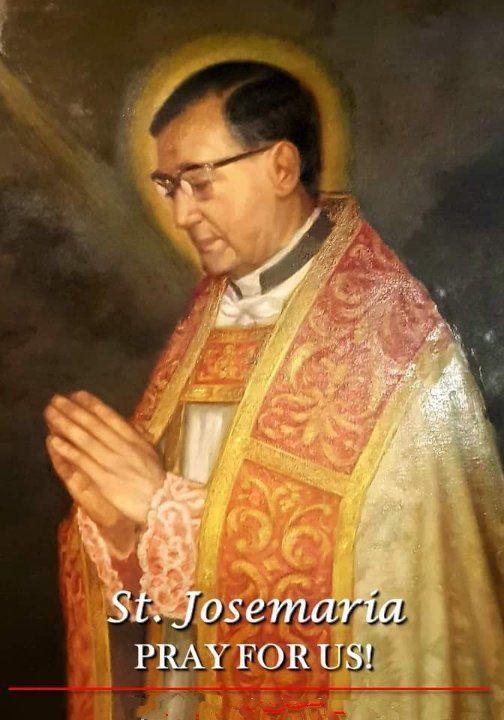
He is commonly portrayed wearing priestly vestments, holding a crucifix, carrying books, teaching laypeople, or surrounded by workers and families, reflecting his mission of bringing holiness into ordinary life.
WHY HE STILL MATTERS
Modern life often makes it difficult to balance faith, work, and family responsibilities. St. Josemaría reminds us that God is present in our homes, workplaces, and daily duties. Holiness is found not by escaping ordinary life but by living it with love, faith, and fidelity.
THE SAINT OF THE ORDINARY
St. Josemaría Escrivá did not become known through martyrdom or extraordinary miracles but through a vision that transformed countless lives. He taught that the road to heaven passes through ordinary homes, schools, offices, workshops, hospitals, farms, and places of work. By filling everyday life with God’s presence, he helped millions rediscover the Gospel truth that every person is called to be a saint.
PRAYER
Saint Josemaria, may your intercession help us to follow your teachings in making our daily labors divine labors. May our work, well done, mingle with Christ’s work and sacrifice to form one perfect offering of praise and thanksgiving, to God the Father. May we strive towards perfection, as God wants us to, and aspire to live saintly lives, abiding in Christ Jesus. Amen

======================================================================
ALSO CELEBRATED
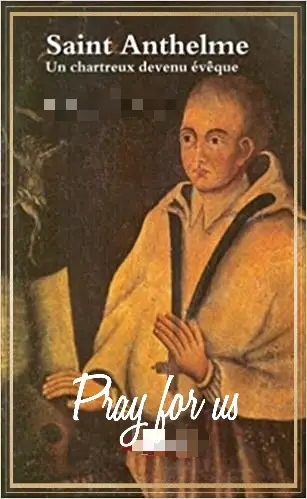
FEAST OF SAINT ANTHELM OF BELLEY
FEAST DAY – 26th JUNE

Anthelm of Belley (1107–1178) was a prior of the Carthusian Grand Chartreuse and bishop of Belley. He was born near Chambéry in 1107. He would later receive an ecclesiastical benefice in the area of Belley. When he was thirty years old, he resigned from this position to become a Carthusian monk at Portes. Only two years after joining the order, he was made the prior of the Grande Chartreuse, the motherhouse of his order, which had recently incurred substantial damage.
He was an effective administrator there. While under his direction, the community increased in numbers and fervency. He restored and improved the buildings, including constructing a defensive wall and an aqueduct. The rules of the order were standardized, and changed to allow women the opportunity to enter the order in their own houses. He also brought the other houses of the order into closer alignment with the motherhouse. The monks under his direction included Hugh of Lincoln, who expressed great fondness for Anthelm.
Anthelm continued in his office almost constantly for twenty-four years, barring a period of a few years when he was a hermit. After that period, in 1152, Anthelm returned to the Grand Chartreuse, and helped defend the sitting Pope Alexander III against the antipope Victor IV. Alexander III appointed Anthelm bishop of Belley in 1163.
In that position, he is said to have been fearless and uncompromising, working to reform the clergy and regulate the affairs of the diocese. One example of his fearlessness occurred in 1175, when Anthelm excommunicated Count Humbert of Maurienne for having taken one priest captive and murdering another priest who had tried to free him.
Humbert appealed his excommunication to Pope Alexander III, who reversed Humbert’s excommunication. Anthelm, who believed that Humbert was not penitent for his misconduct, withdrew from his diocese in protest. Pope Alexander then commissioned Anthelm to travel to England to try to reconcile Henry II of England and Thomas Becket.
Anthelm’s health was such that he was unable to take the journey. Anthelm returned to Belley to help care for the poor and the lepers of the area. Anthelm died at Belley in 1178. On his deathbed, he received Humbert, and recognized that at that time Humbert truly had repented of his earlier acts.
He is considered a saint of the Roman Catholic Church, with a feast day of June 26. His feast has been celebrated by the Carthusians since 1607. His relics were enshrined in Belley. In art, Anthelm is depicted holding a lamp lit by a divine hand.
PRAYER
God, You made Your Bishop St. Anthelm an outstanding minister of Your Church by his prayer and pastoral zeal. Through his prayers grant that Your faithful flock may always find pastors after Your heart. In Jesus’ Name. Amen