
Day Twenty-Four of Lent – The Gaze of Mother and Son
March 17, 2026
Proverbs 3:5-6
March 17, 2026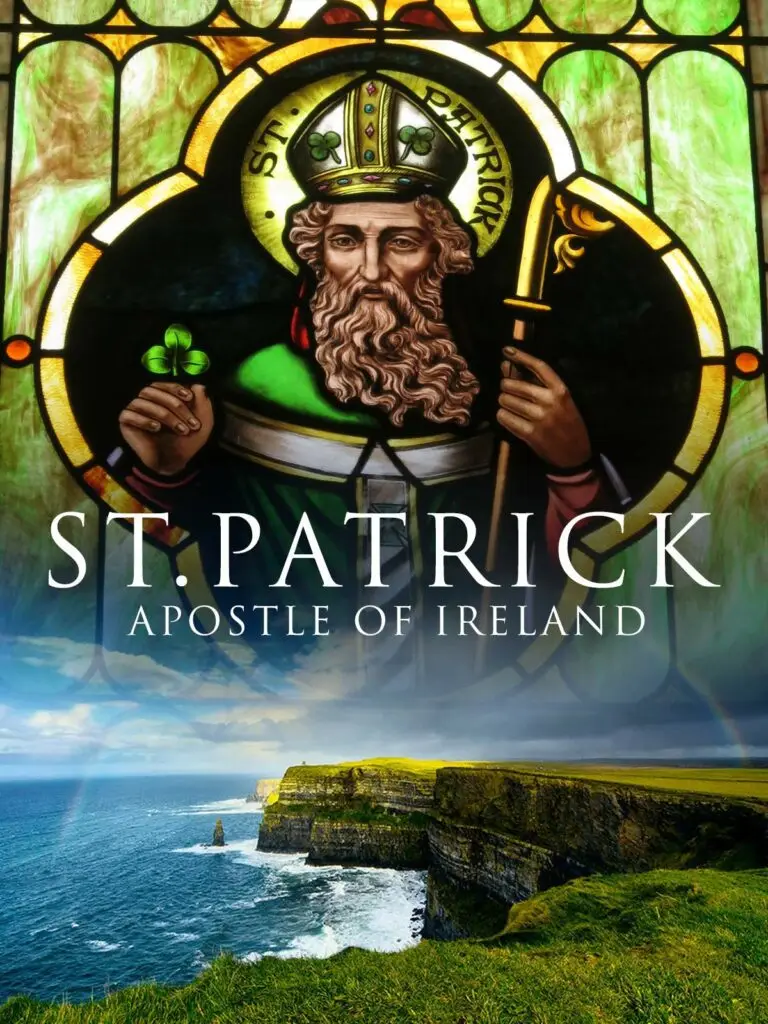
FEAST OF SAINT PATRICK, APOSTLE OF IRELAND ☘☘☘☘☘
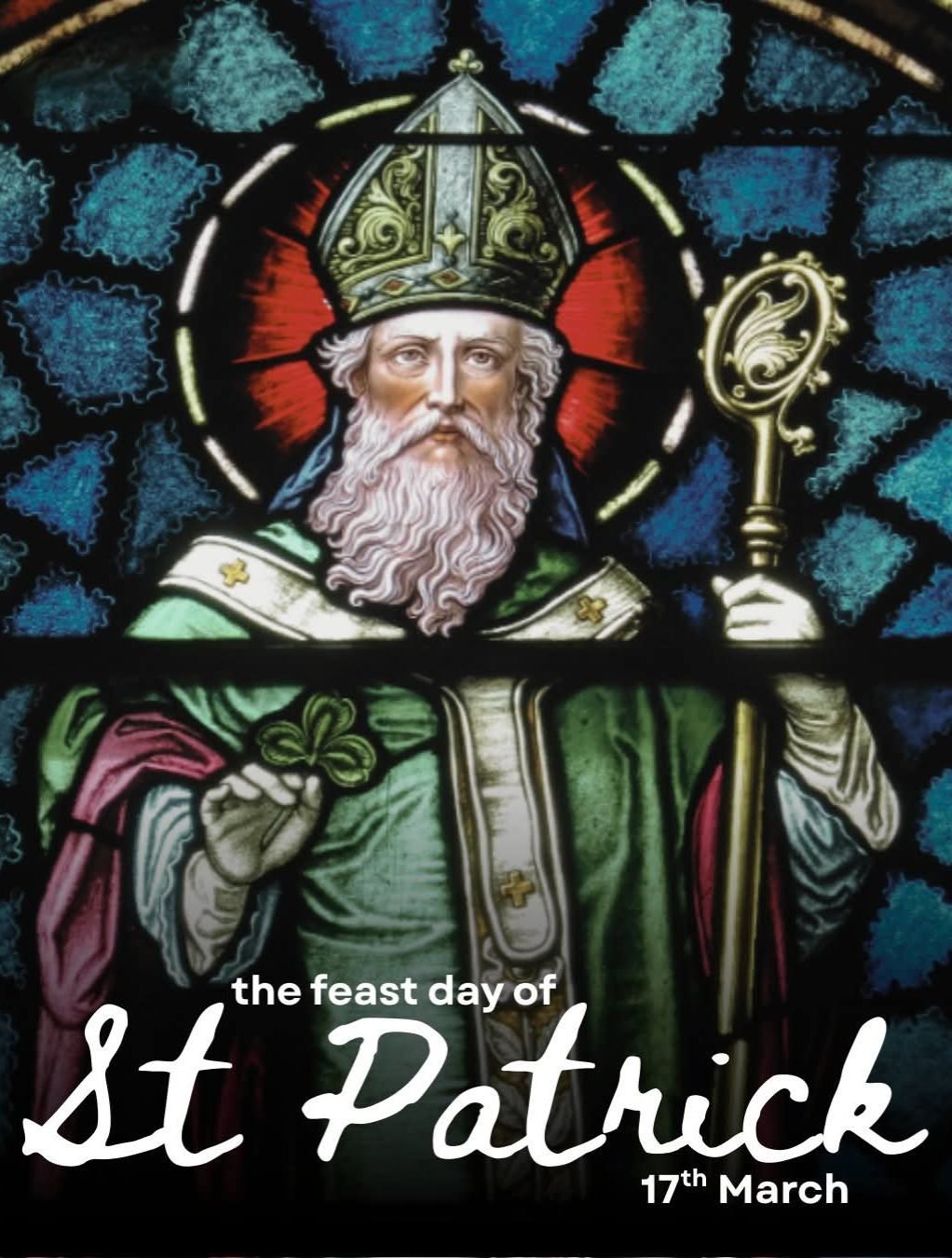
ST. PATRICK’S DAY☘
FEAST DAY – 17th MARCH
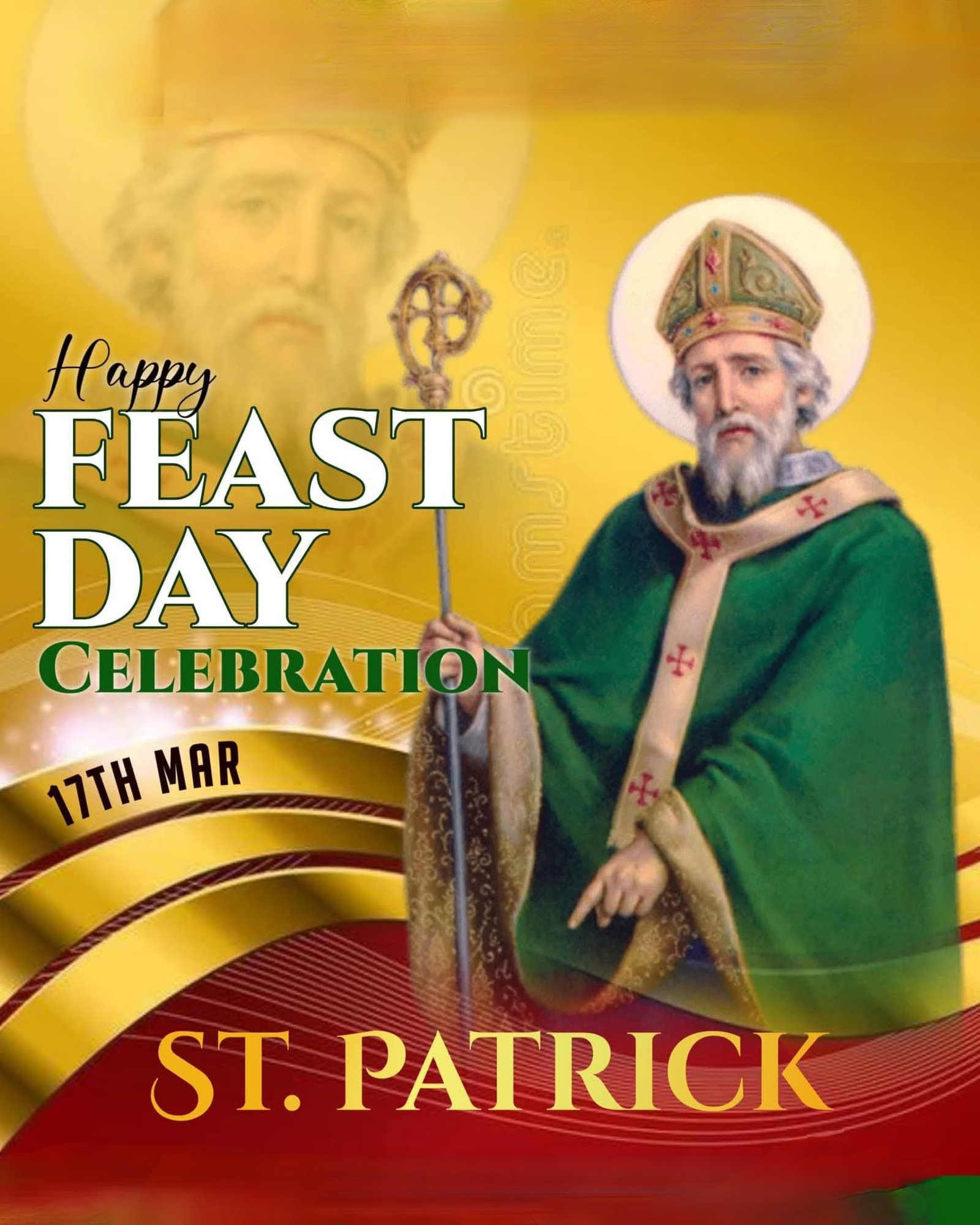
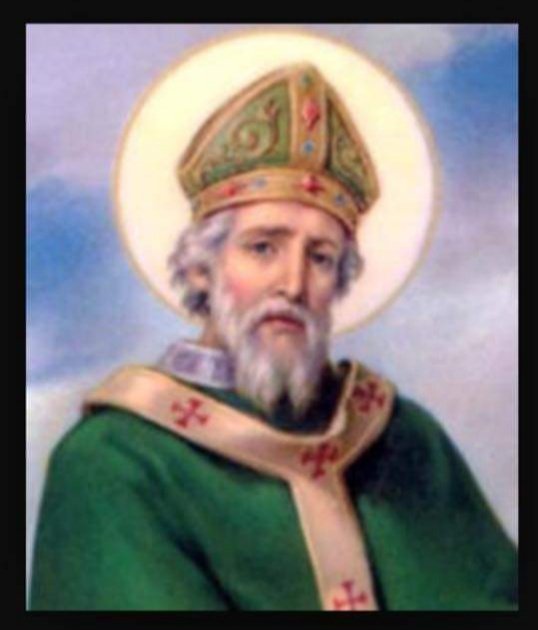
Saint Patrick was a fifth-century Romano-British Christian missionary and bishop in Ireland. Known as the “Apostle of Ireland”, he is the primary patron saint of Ireland, the other patron saints being Brigit of Kildare and Columba.
Patrick was never formally canonised, having lived prior to the current laws of the Catholic Church in these matters. Nevertheless, he is venerated as a Saint in the Catholic Church and in the Eastern Orthodox Church, where he is regarded as equal-to-the-apostles and Enlightener of Ireland.
He is also regarded as a Saint within the framework of their respective doctrine by the Anglican Communion and the Lutheran Churches. The dates of Patrick’s life cannot be fixed with certainty, but there is general agreement that he was active as a missionary in Ireland during the fifth century. A recent biography on Patrick shows a late fourth-century date for the saint is not impossible. Early medieval tradition credits him with being the first bishop of Armagh and Primate of Ireland, and regards him as the founder of Christianity in Ireland, converting a society practising a form of Celtic polytheism.
According to the autobiographical Confession of Patrick, when he was about sixteen, he was captured by Irish pirates from his home in Britain and taken as a slave to Ireland, looking after animals; he lived there for six years before escaping and returning to his family. After becoming a cleric, he returned to northern and western Ireland. In later life, he served as a bishop. His birthplace is not known but some traditions place it in what is now England—one identifying it as Glannoventa (modern Ravenglas).
Patrick’s father, Calpurnius, is described as a decurion (Senator and tax collector) of an unspecified Romano-British city, and as a deacon; his grandfather Potitus was a priest from Bonaven Tabernia. However, Patrick’s confession states he was not an active believer in his youth.
At the age of sixteen he was captured by a group of Irish pirates, from his family’s Villa at “Bannavem Taburniae”. They took him to Ireland where he was enslaved and held captive for six years.
Patrick writes in the Confession that the time he spent in captivity was critical to his spiritual development. He explains that the Lord had mercy on his youth and ignorance, and afforded him the opportunity to be forgiven his sins and convert to Christianity. While in captivity, he worked as a shepherd and strengthened his relationship with God through prayer, eventually leading him to convert to Christianity.
After six years of captivity he heard a voice telling him that he would soon go home, and then that his ship was ready. Fleeing his master, he travelled to a port, two hundred miles away, where he found a ship and with difficulty persuaded the captain to take him. After three days’ sailing, they landed, presumably in Britain, and apparently all left the ship, walking for 28 days in a “wilderness” and becoming faint from hunger. After Patrick prayed for sustenance, they encountered a herd of wild boar; since this was shortly after Patrick had urged them to put their faith in God, his prestige in the group was greatly increased.
After various adventures, he returned home to his family, now in his early twenties. After returning home to Britain, Patrick continued to study Christianity. Much of what is known about Saint Patrick comes from the Declaration, which was written by Patrick himself. After making his way home, Patrick went on to become a priest. According to tradition, Patrick returned to Ireland to convert the pagan Irish to Christianity.
Utterly confident in the Lord, he journeyed far and wide, baptizing and confirming with untiring zeal. In diplomatic fashion he brought gifts to a kinglet here and a lawgiver there but accepted none from any. On at least one occasion, he was cast into chains. On another, he addressed with lyrical pathos a last farewell to his converts who had been slain or kidnapped by the soldiers of Coroticus.
The evocation of such incidents of what he called his “laborious episcopate” was his reply to a charge, to his great grief endorsed by his ecclesiastical superiors in Britain, that he had originally sought office for the sake of office. In point of fact, he was a most humble-minded man, pouring forth a continuous paean of thanks to his Maker for having chosen him as the instrument whereby multitudes who had worshipped “idols and unclean things” had become “the people of God.”
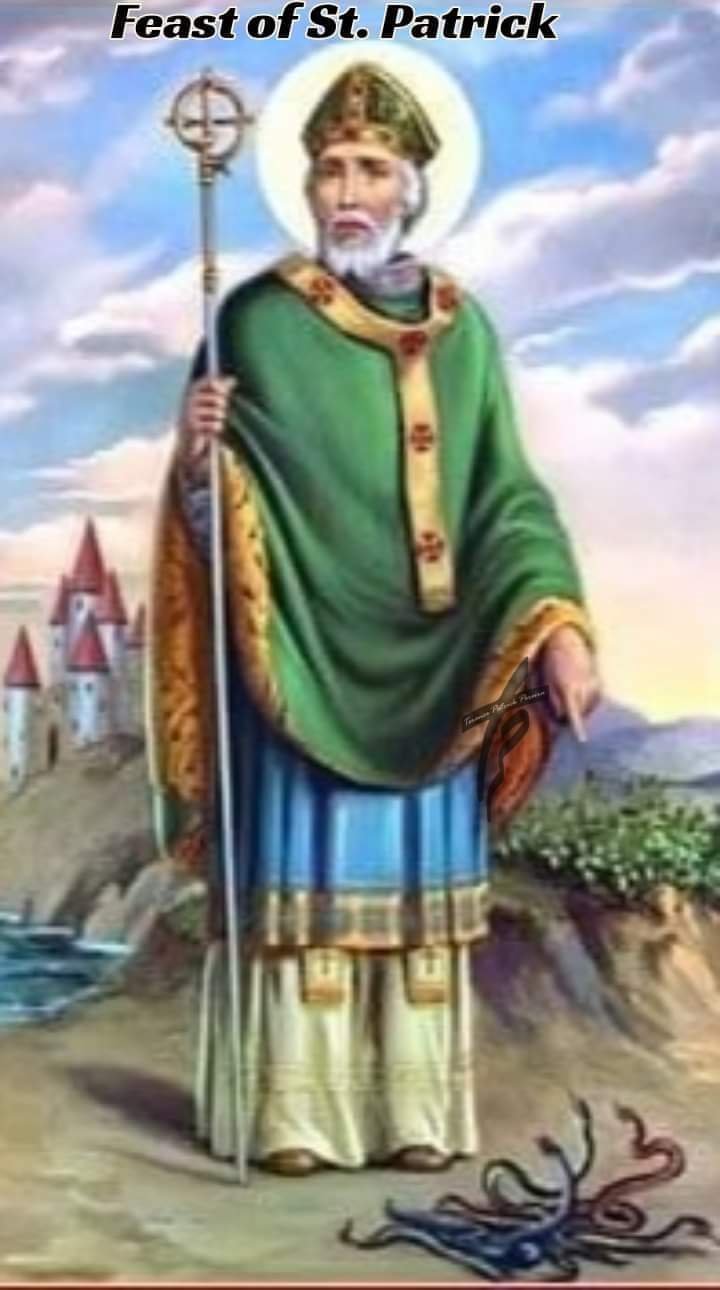
The Declaration says that he spent many years evangelizing in the northern half of Ireland and converted thousands. Patrick’s efforts against the druids were eventually turned into an allegory in which he drove “snakes” out of Ireland, despite the fact that snakes were not known to inhabit the region. Tradition holds that he died on 17 March and was buried at Downpatrick. Over the following centuries, many legends grew up around Patrick and he became Ireland’s foremost saint.
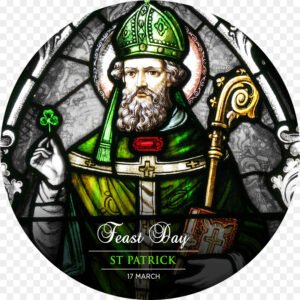
St. Patrick of Ireland is one of the world’s most popular saints. In The Confession, he wrote:
“The love of God and his fear grew in me more and more, as did the faith, and my soul was rosed, so that, in a single day, I have said as many as a hundred prayers and in the night, nearly the same. I prayed in the woods and on the mountain, even before dawn. I felt no hurt from the snow or ice or rain.”
A few years after returning home, Patrick saw a vision he described in his memoir:
“I saw a man coming, as it were from Ireland. His name was Victoricus, and he carried many letters, and he gave me one of them. I read the heading: ‘The Voice of the Irish.’ As I began the letter, I imagined in that moment that I heard the voice of those very people who were near the wood of Foclut, which is beside the western sea-and they cried out, as with one voice: ‘We appeal to you, holy servant boy, to come and walk among us.'”
The vision prompted his studies for the priesthood. He was ordained by St. Germanus, the Bishop of Auxerre, whom he had studied under for years, and was later ordained a bishop and sent to take the Gospel to Ireland. Patrick arrived in Slane, Ireland on March 25, 433. There are several legends about what happened next, with the most prominent claiming he met the chieftain of one of the druid tribes, who tried to kill him.
After an intervention from God, Patrick was able to convert the chieftain and preach the Gospel throughout Ireland. There, after converting thousands, he began building churches across the country. He often used shamrocks to explain the Holy Trinity and entire kingdoms were eventually converted to Christianity after hearing Patrick’s message. Patrick preached and converted all of Ireland for 40 years. He worked many miracles and wrote of his love for God in Confessions. After years of living in poverty, traveling and enduring much suffering he died March 17, 461.
He died at Saul, where he had built the first Irish church. He is believed to be buried in Down Cathedral, Downpatrick. His grave was marked in 1990 with a granite stone. Patrick was a humble, pious, gentle man, whose love and total devotion to and trust in God should be a shining example to each of us. So complete was his trust in God, and of the importance of his mission, he feared nothing – not even death.
He is patron of Ireland, Nigeria, Montserrat, Archdiocese of New York, Roman Catholic Archdiocese of Newark, Boston, Rolla, Missouri, Loíza, Puerto Rico, Murcia (Spain), Clann Giolla Phádraig.
He is also the patron of engineers, paralegals, Archdiocese of Melbourne, and is invoked against snakes, and sins.
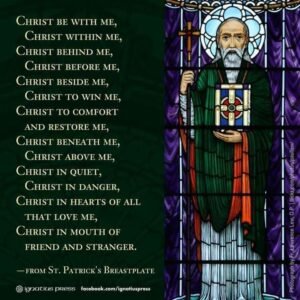
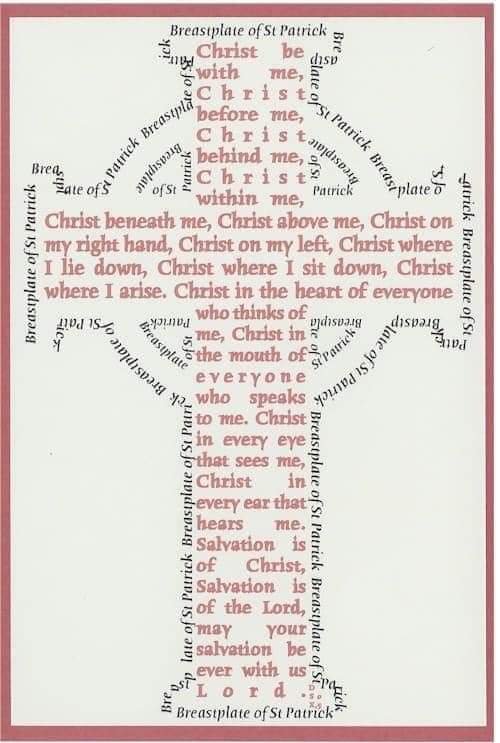
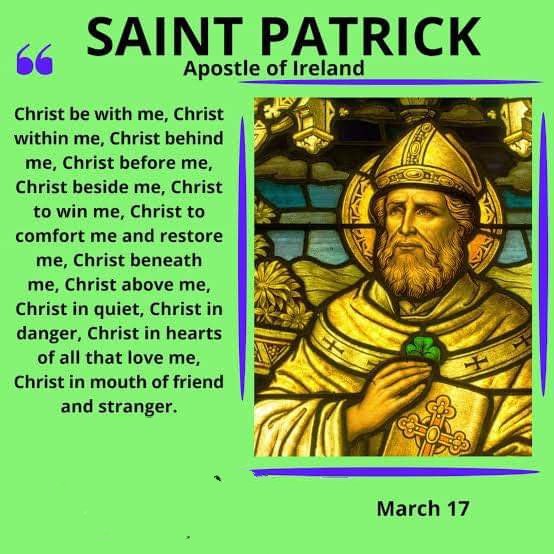
“The Breastplate,” Patrick’s poem of faith and trust in God:
Christ be within me,
Christ behind me,
Christ before me,
Christ beside me,
Christ to win me,
Christ to comfort and restore me,
Christ beneath me,
Christ above me,
Christ inquired,
Christ in danger,
Christ in hearts of all that love me,
Christ in mouth of friend and stranger.
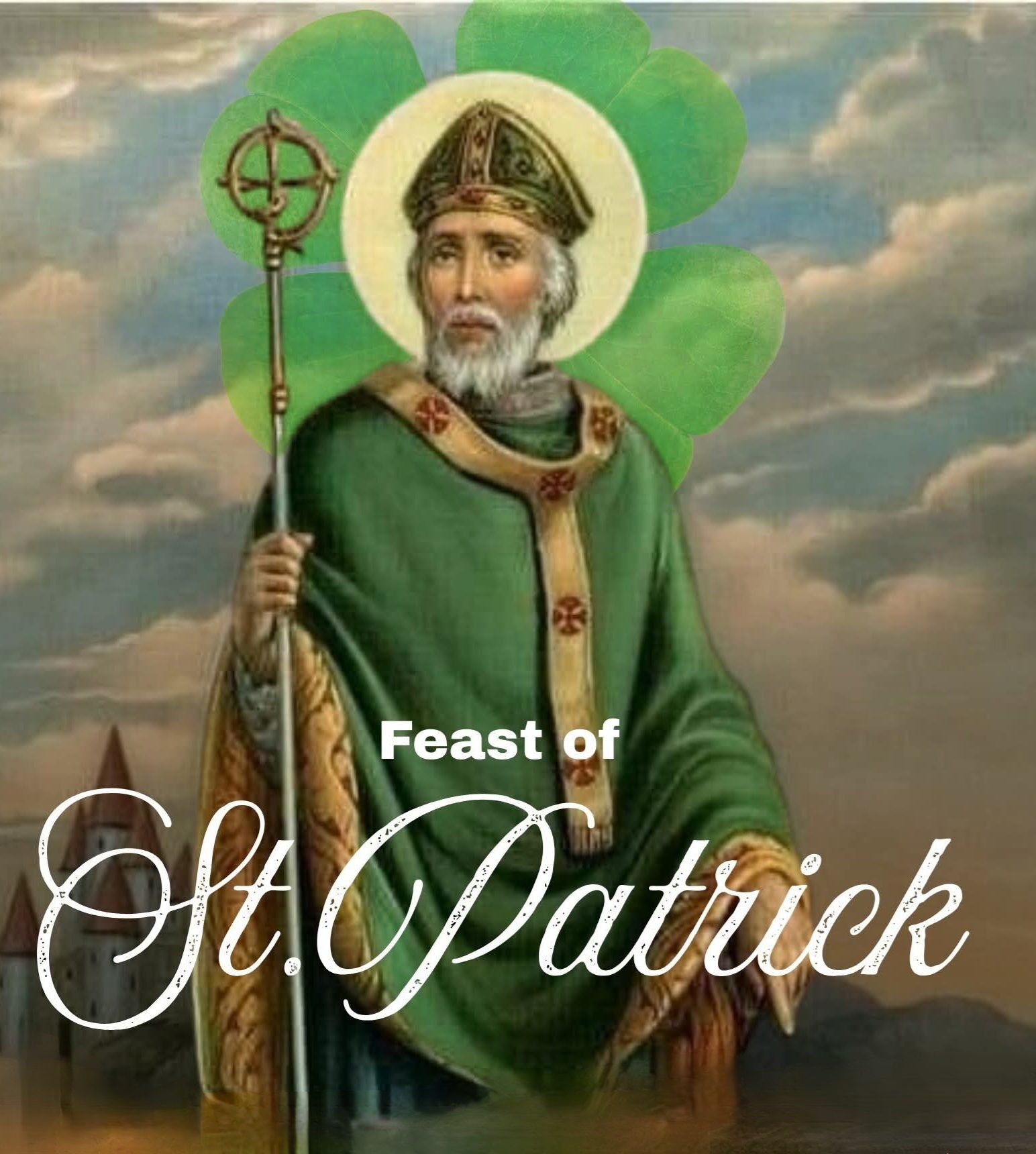
CONTEMPLATING THE LIFE OF SAINT PATRICK (c. 385-461)
Patrick is one of the most beloved saints in Christian history. He was a missionary bishop who evangelized Ireland, helping transform a largely pagan society into a Christian one.
Although widely associated with Irish culture, Patrick himself was not Irish by birth. His life story – filled with captivity, conversion, mission, and perseverance – became a powerful testimony of God’s providence.
His feast day is celebrated worldwide on 17 March, especially in Ireland.
FROM SLAVE TO APOSTLE: THE JOURNEY OF ST. PATRICK
Early Life
In the fading days of the Roman Empire, in a quiet village of Roman Britain, probably somewhere in present-day England, Scotland, or Wales, a boy was born into a Christian family. His name was Patrick.
His father Calpurnius was a deacon and his grandfather a priest, yet Patrick later admitted that as a boy he did not care much about faith.
Life seemed ordinary and comfortable.
Until the night everything changed.
The Night of Captivity
Patrick was only sixteen years old when raiders from Ireland attacked his village. Homes were burned. People were taken prisoner. Patrick was dragged onto a ship and carried across the sea to a strange land. There he was sold as a slave.
For six long years he lived alone on the cold hills of Ireland, tending sheep for his master. There were no friends. No family. Only silence. But it was in that loneliness that something began to grow in Patrick’s heart. He began to pray.
He later wrote in his spiritual autobiography, Confessio:
“I prayed many times a day… and the love of God increased in me more and more.”
The boy who once ignored God now prayed hundreds of times each day. Prayer became the source of his strength. Captivity had become the path to faith.
The Dream of Freedom
One night Patrick had a dream. A voice spoke to him:
“Your ship is ready.”
Believing God had spoken to him, Patrick escaped. He walked nearly 200 miles across Ireland until he reached the coast. There he found a ship sailing for Britain. After years of slavery, he finally returned home. His family rejoiced.
But Patrick’s story was not finished.
The Call to Return
Soon Patrick had another dream. In the dream he saw a man bringing letters from Ireland. As he read them, he heard the voices of the Irish people crying out:
_“We beg you, holy youth, come and walk among us again.”_ Patrick understood this as a call from God.
The land that had once enslaved him was now the land he was called to serve. He studied for many years and was eventually ordained a bishop. Then he returned to Ireland – not as a slave, but as a missionary.
The Apostle of Ireland
Ireland at that time was deeply influenced by druid priests and pagan traditions.
But Patrick traveled across the island preaching the Gospel.
* He baptized thousands.
* He ordained priests.
* He established Christian communities and monasteries.
The Shamrock and the Trinity
One of the most famous traditions about St. Patrick concerns the shamrock, a small three-leaf plant common in Ireland.
According to tradition, Patrick used the shamrock to explain the mystery of the Holy Trinity. Just as the shamrock has three leaves but remains one plant, God is three persons in one divine nature. Gradually the light of Christianity spread throughout Ireland.
His Writings
Two authentic works written by Patrick survive:
Confessio A spiritual autobiography describing his faith journey
Letter to the Soldiers of Coroticus condemning the killing and enslavement of Irish Christians.
These writings reveal a humble man deeply aware of his weaknesses yet confident in God’s grace.
The Saint Who Forgave
Perhaps the most extraordinary part of Patrick’s story is that he returned to the very people who had enslaved him.
* Not with anger.
* Not with revenge.
* But with the message of Christ. His life became a testimony that God can transform suffering into mission.
The Final Years
Patrick spent decades traveling across Ireland preaching and baptizing. By the time he died around 461, the foundations of Christianity had been firmly planted across the island. He died in Downpatrick. But the faith he planted continued to grow.
Legacy
Patrick’s mission transformed Ireland. Within a few centuries, Ireland became one of the great centers of Christian learning and missionary activity in Europe.
Irish monks later helped evangelize much of northern Europe during the early Middle Ages. Because of this influence, Patrick is remembered as the Apostle of Ireland.
Patronage
St. Patrick is the patron saint of:
* Ireland
* engineers
* missionaries.
His feast, St. Patrick’s Day, is celebrated worldwide with religious and cultural festivities.
In summary
St. Patrick’s life is a powerful story of captivity turned into mission. Through prayer, courage, and forgiveness, he became the missionary who brought the Christian faith to Ireland and inspired generations of believers.
PRAYER
Almighty Father, your humble servant Saint Patrick is recommended for the durability of his efforts. When one considers the state of Ireland when he began his mission work, the vast extent of his labors, and how the seeds he planted continued to grow and flourish, one can only admire the kind of man Patrick must have been.
The holiness of a person is known only by the fruits of his or her work. May we be so edified by his example that we labor honestly and in simplicity to spread the Gospel message to all people.
May your Wisdom instruct us. May your Hand protect us. May your Way, O God, direct us. May your Shield, O God, defend us. In Jesus’ Name. Amen
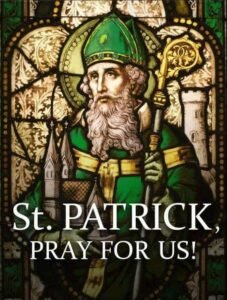
Saint Patrick, pray for us.
☘ SAINT PATRICK’S DAY ☘
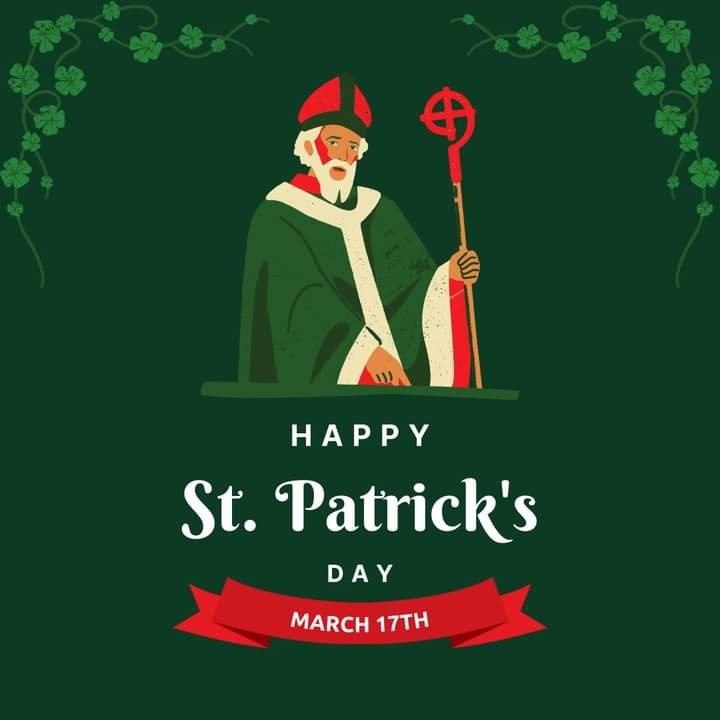
It was emigrants, particularly to the United States, who transformed St. Patrick’s Day into a largely secular holiday of revelry and celebration of things Irish. Cities with large numbers of Irish immigrants, who often wielded political power, staged the most extensive celebrations, which included elaborate parades.
Irish and non-Irish alike commonly participate in the “wearing of the green”—sporting an item of green clothing or a shamrock, the Irish national plant, in the lapel. Corned beef and cabbage are associated with the holiday, and even beer is sometimes dyed green to celebrate the day. Although some of these practices eventually were adopted by the Irish themselves, they did so largely for the benefit of tourists.
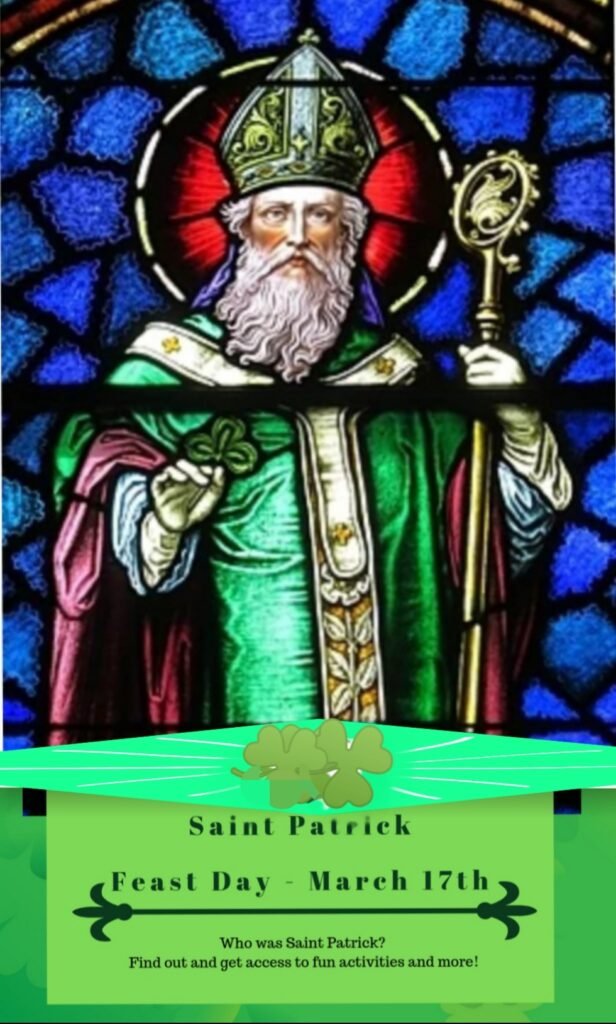
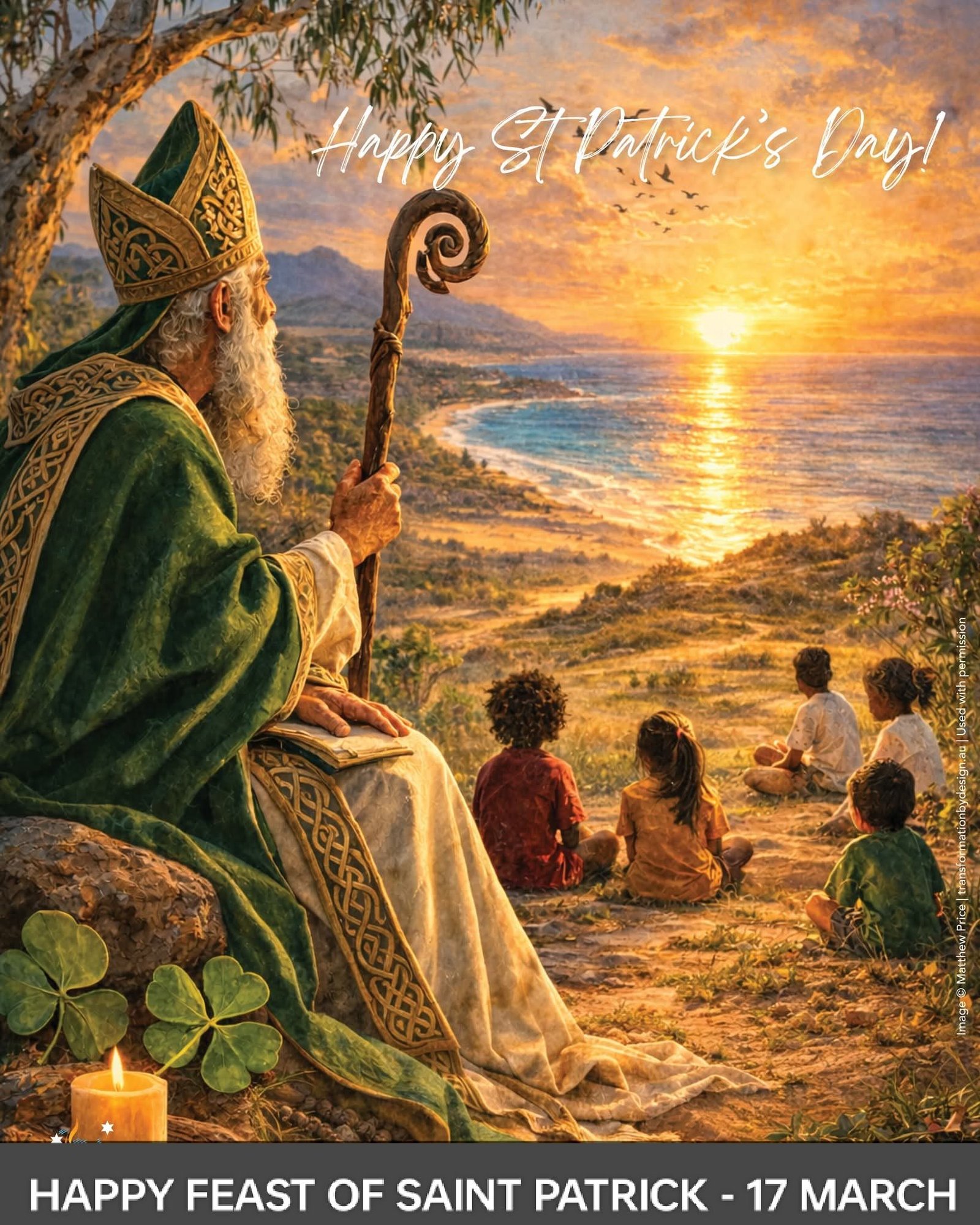
HAPPY FEAST OF ☘ SAINT PATRICK☘
HAPPY SAINT PATRICK’S DAY!☘