
Honoring Mother Mary: Why May Is the Month of Mary
April 29, 2026
Acts 10:43
April 30, 2026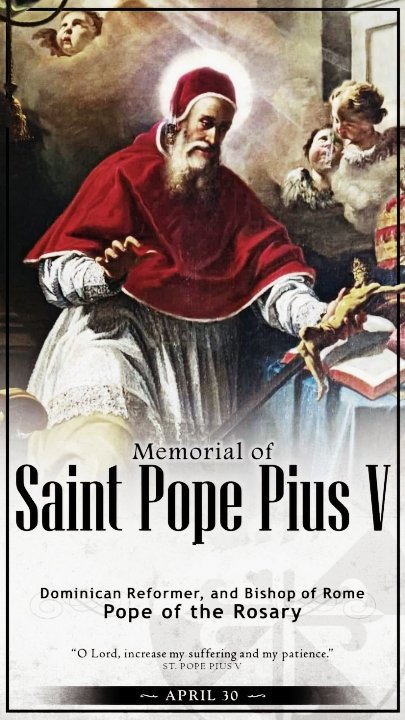
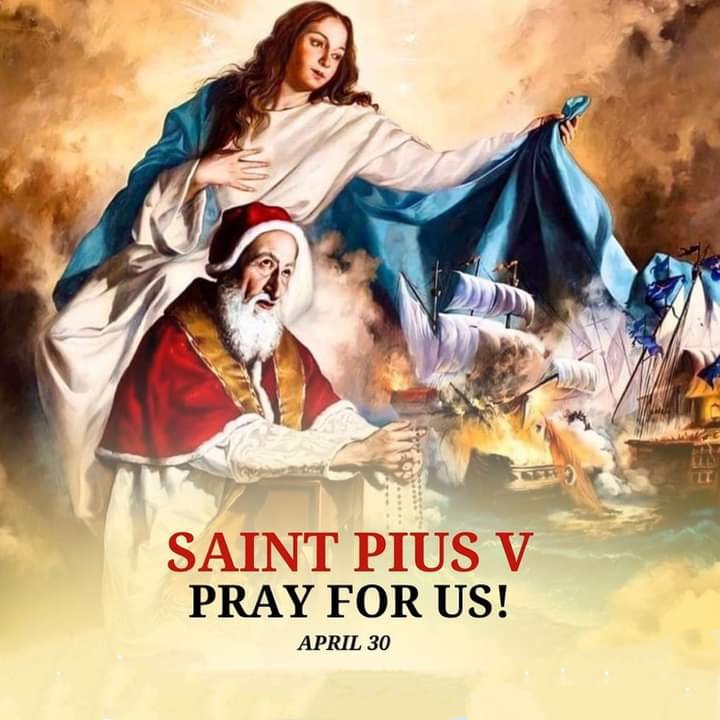
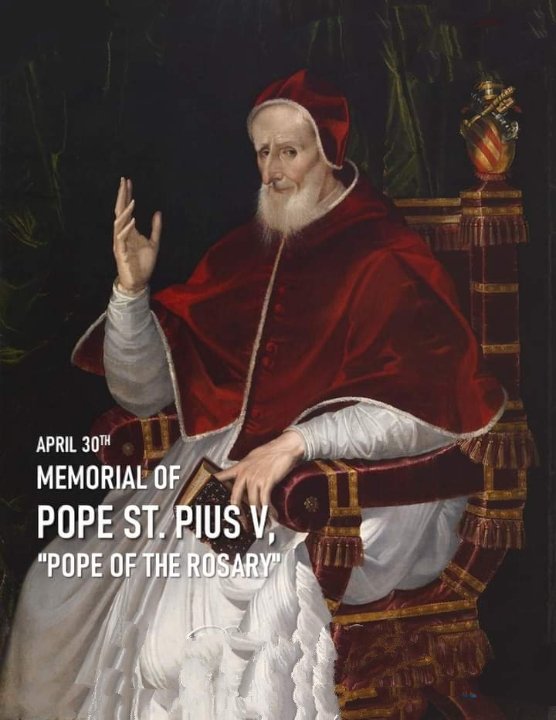
FEAST OF SAINT POPE PIUS V
FEAST DAY – 30th APRIL
Saint Pius V is buried in the Sistine Chapel, but not THE Sistine Chapel. His body lies in a glass coffin in the stunning, baroque, Sistine Chapel of the Basilica of Saint Mary Major in Rome. He is not far from other luminaries: the master artist Gianlorenzo Bernini is buried unassumingly in the floor nearby, and Saint Jerome’s remains are found in a porphyry tomb under the main altar.
Saint Pius was from a poor but noble family in Northern Italy and baptized Antonio Ghislieri. He entered the Dominican Order as a teenager and quickly rose to positions of authority and responsibility due to his intelligence, discipline, unassailable purity of life, and defense of the Church.
He was elected Pope in 1566. The Council of Trent had just concluded. The Counter-Reformation was so new it did not even have a name. The Muslim Turks were invading Europe from the East. Protestants occupied chunks of Northern Europe and were cracking the unity of the Church in France. In a truncated papacy of six years and four months, Saint Pius V rose to all of these challenges and more, leaving an enduring legacy disproportionate to his brief reign.

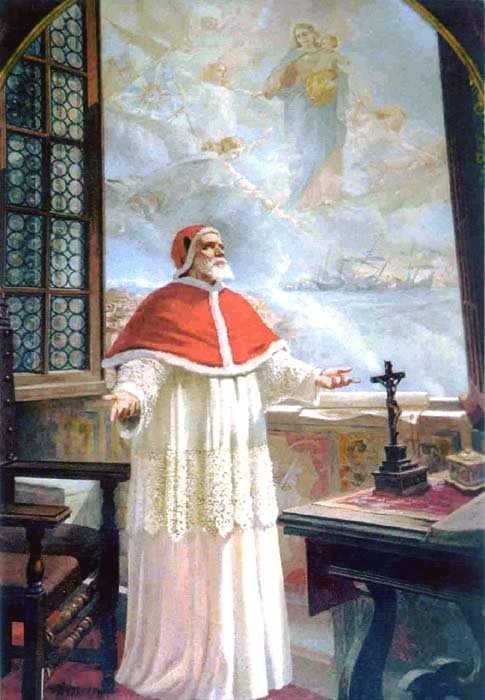
Saint Pius marshalled the coalition of Catholic princes and monarchs who defeated the Turks at the battle of Lepanto in 1571. A loss would have opened the front door of Europe for Muslims to walk right in and make it their home.
In 1570, Pius V excommunicated Queen Elizabeth I of England for heresy and schism, called her a pretender to the throne, and forbade Catholics to obey her.

This led the Queen to seek the blood of English Catholics for treason. As momentous as these events were, and they each cast long and dark historical shadows, it was specifically as a churchman that Saint Pius V did his best work.
He personally lived the reforms he expected of the Church as a whole, and he implemented those reforms first in the city of Rome itself, among his own ecclesial court and among his own people.
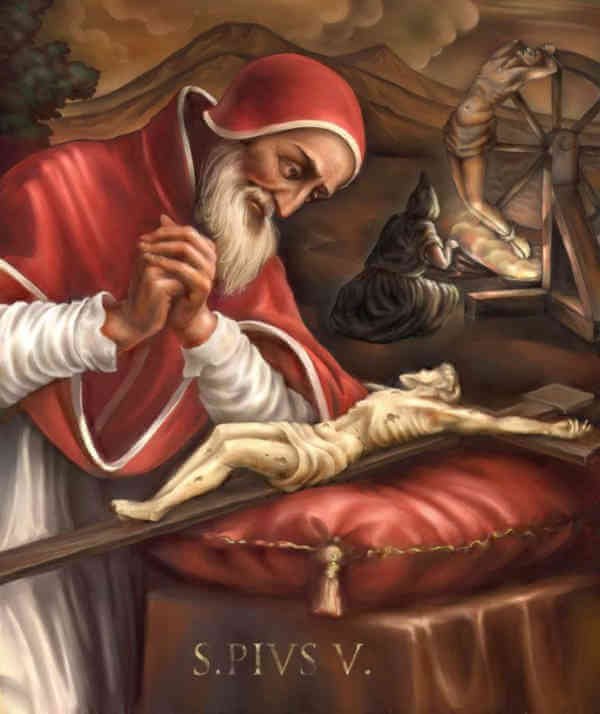
The Council of Trent met intermittently between 1545–1563. It was arguably the most successful Council in the history of the Church. Trent introduced numerous reforms that have long since been accepted as normative Church practice.
A bishop must live in his diocese, priestly formation must occur in a seminary, the Mass must be said using a uniform language and ritual, a catechism must be published and its teachings learned by all, and religious and priests cannot easily skip from one diocese to another.
The Council also clarified technical, and not so technical, questions of Catholic theology in the face of Protestant challenges. The Council’s documents were not put on a shelf to gather dust.
Trent’s immense treasure house of doctrinal, liturgical, and disciplinary reforms were implemented, fully and forcefully, over many succeeding decades. This was due to the perseverance and vision of many Counter-Reformation bishops, priests, nuns, and scholars, beginning with Saint Pius V himself.

Saint Pius V is considered an icon of orthodoxy (correct teaching) and orthopraxy (correct practice). It is an unfortunate truism of modernity that religious faith, submission to religious truth, or trust in a prior intellectual inheritance (as opposed to personal discovery of “truth”) are limiting forces which stunt personal growth.
They are responsible for shielding the believer from reality, and they prove to be stumbling blocks to more daring inquiry. A more honest perspective disproves these snide conclusions.
Doubt, refusal, or negation are not necessarily open-minded pathways to discovery. It is acceptance, affirmation, and faith that open the mind to the widest horizons. It is “Yes,” not “No,” that leads to more complex and demanding relationships, including with God Himself.
The orthodox believer makes no a priori decision to shut his eyes to the fullness of reality, in contrast to the atheist. The believer is open, truly open, to diverse arguments and experiences.
Defenders of orthodoxy, like St. Pius V, have far more complex understandings of human anthropology and religion than commonly acknowledged. Conservatives are more intuitive anthropologists than liberals.
They know how fragile truth can be when under pressure, and they take their job to protect it with utmost seriousness. Saint Pius V was the Pope, or Father, of a universal family.
He protected the family’s unity with all his considerable skills and virtues, and left a highly united, disciplined Church as his legacy.

CONTEMPLATING THE LIFE OF SAINT POPE PIUS V
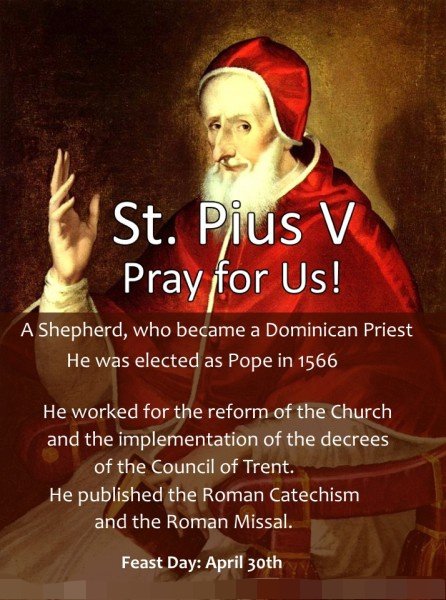
St. Pius V, who reigned from 1566 to 1572, was a Dominican friar who became pope and emerged as one of the central figures of the Counter-Reformation. He is remembered for his personal holiness, firm reforms, defense of doctrine, and promotion of the liturgy, as well as for his role during a decisive period in European history.
He was born in 1504 in Bosco, Italy, and died in 1572 in Rome. His feast day is celebrated on April 30. He belonged to the Dominican Order. He lived in the period following the Council of Trent, when the Church was actively reforming itself in response to internal corruption and the Protestant Reformation.
THE MONK WHO BECAME A STORM OF REFORM
A CHILD OF POVERTY, A HEART FOR TRUTH
Born into a poor village in Italy, Antonio Ghislieri grew up with very little, but he possessed a deep seriousness about life. He was formed by hard work, discipline, and a strong desire for truth. Though he inherited no power or privilege, he carried within him a deep hunger for what is right and true.
THE CLOAK OF A DOMINICAN
He entered the Order of Preachers, the Dominicans, where he was formed in theology, discipline, and preaching. He learned to think clearly, pray deeply, and live simply. He became known for his austerity, integrity, and unwavering commitment to truth. At a time when the world and the Church were undergoing great change, he responded not with fear but with deeper formation and fidelity.
A MAN WHO WOULD NOT COMPROMISE
As he rose through positions of responsibility as inquisitor, bishop, and cardinal, he remained unchanged in his principles and simple in his way of life. He sought not approval but fidelity. Where others weakened the truth, he clarified it; where corruption was ignored, he addressed it firmly and consistently. His life already reflected the reforms the Church needed.
A CHURCH IN NEED OF FIRE
By the time he became pope in 1566, the Church was facing division after the Reformation, internal corruption, and confusion among the faithful. The Council of Trent had given direction, but it required strong leadership to bring those reforms into action. Antonio Ghislieri, now Pope Pius V, stepped into this mission.
REFORM THAT COST SOMETHING
He began reform not with others but with himself, continuing to live simply and pray deeply. He then worked to reform the clergy, enforce discipline, and correct abuses throughout the Church. His reforms were not selective but consistent, rooted in conviction rather than convenience.
ORDER IN WORSHIP, CLARITY IN FAITH
Pius V understood that confusion in worship leads to confusion in belief. One of his lasting contributions was the standardization of the Mass through the Roman Missal of 1570, often known as the Tridentine Mass. This brought unity, clarity, and consistency to Catholic worship, shaping the liturgy for centuries.
DEFENDER OF DOCTRINE
He firmly upheld Catholic teaching, opposed theological errors, strengthened catechesis, and ensured that the faith was clearly taught and protected. He believed that truth must not only be preserved but also proclaimed with clarity.
A STORM FROM THE SEA
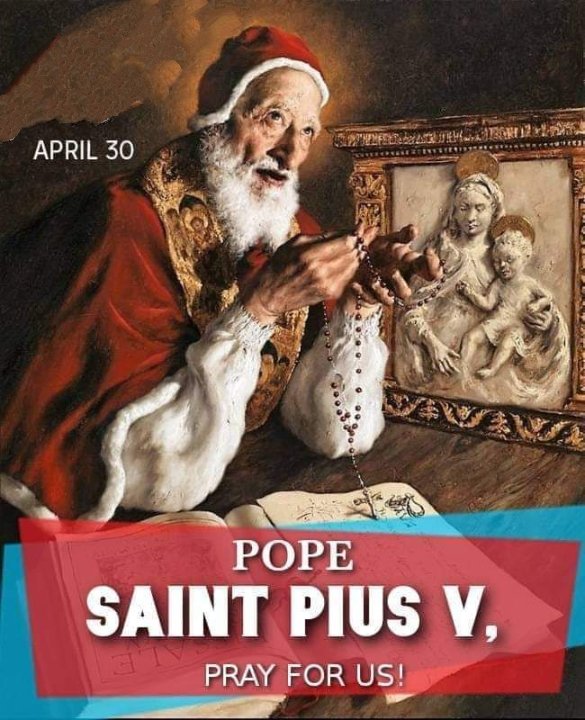
During his papacy, a serious external threat arose as the Ottoman fleet advanced toward Europe. The decisive moment came at the Battle of Lepanto. In the face of this crisis, Pius V turned first to prayer rather than strategy.
THE WEAPON OF THE ROSARY
He called all Christians to pray the Rosary and entrusted the situation to the intercession of the Blessed Virgin Mary. The Rosary spread across nations, prayed by the faithful in every condition of life. When victory came, Pius V attributed it not to human strength alone but to divine grace.
DEVOTION TO THE ROSARY
Following the victory at Lepanto, he strongly promoted devotion to the Rosary and established a feast in honor of Our Lady, later known as Our Lady of the Rosary, highlighting the power of prayer in the life of the Church.
THE MONK WHO NEVER LEFT HIS CELL
Even as pope, he continued to live like a monk, embracing simplicity in his surroundings, food, and personal habits. He remained deeply devoted to prayer, gave generously to the poor, and maintained strict personal discipline. His identity was rooted not in authority but in God.
SPIRITUAL CHARACTER
St. Pius V is remembered for integrity, as he lived what he taught; for courage, as he faced both internal and external challenges; for discipline, as he consistently upheld reform; and for prayerfulness, as his strength came from deep union with God.
SPIRITUAL SIGNIFICANCE
He stands as a pope of reform, showing that renewal begins with personal holiness and discipline. He is a defender of truth, reminding us of the importance of clarity in faith. He is also a leader rooted in prayer, whose actions flowed from deep spiritual conviction.
KEY THEMES FROM HIS LIFE
His life highlights reform through holiness, showing that true change begins within. It emphasizes unity in worship, revealing how liturgy shapes belief. It reflects courage in leadership, demonstrating the need for firm decisions. It also unites prayer and action, showing that spiritual life fuels mission.
A LIFE COMPLETED IN FIDELITY
When he died in 1572, he left behind no personal wealth or legacy of self-interest, but a strengthened Church, a clarified faith, and a powerful witness of integrity. He did not seek greatness, but faithfulness, and through that faithfulness, he became truly great.
PRAYER
Saint Pius V, your dedication to the truth showed itself in your pristine holiness, unity of life, and defense of doctrine.
From your home in heaven, assist all theologians and leaders of the Church to be as concerned as you were for the unity of God’s family on earth.
Saint Pius V, pray for us all.