
SPIRITUAL INSIGHTS INTO THE LIFE OF SAINT PAPHNUTIUS
September 11, 2026
Matthew 11:28
September 12, 2026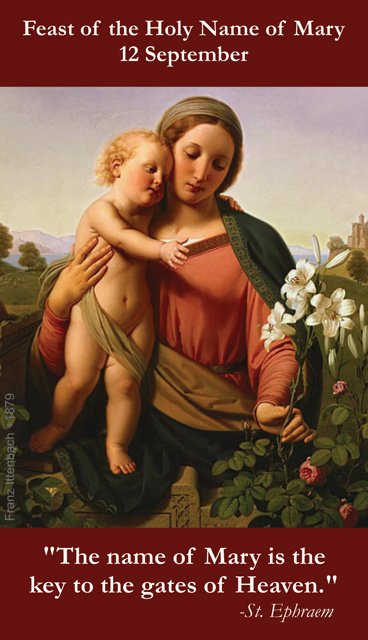
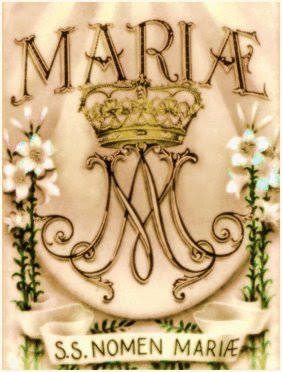
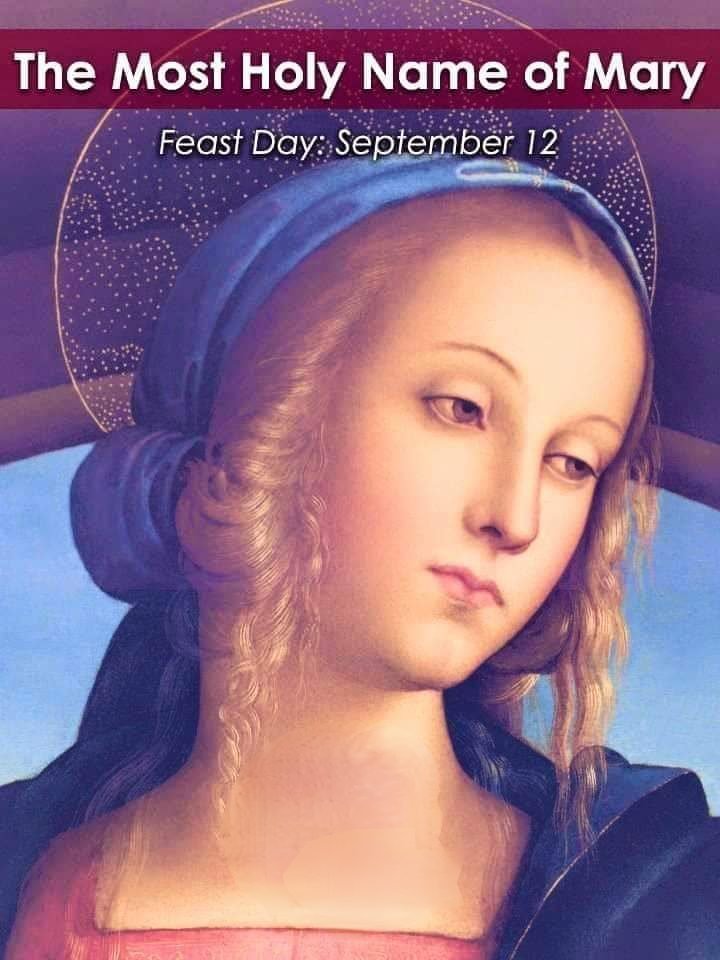
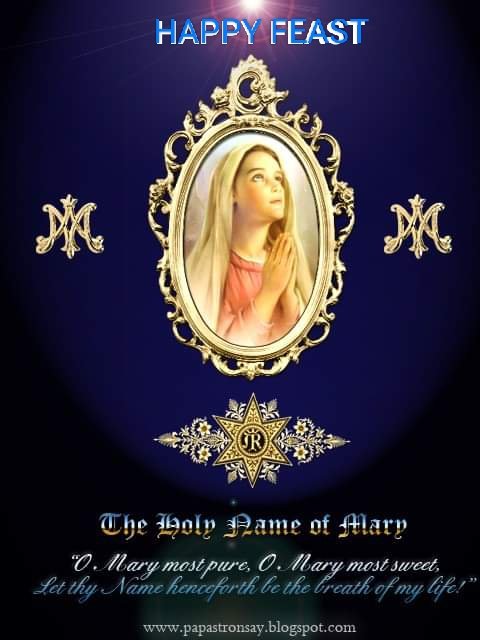
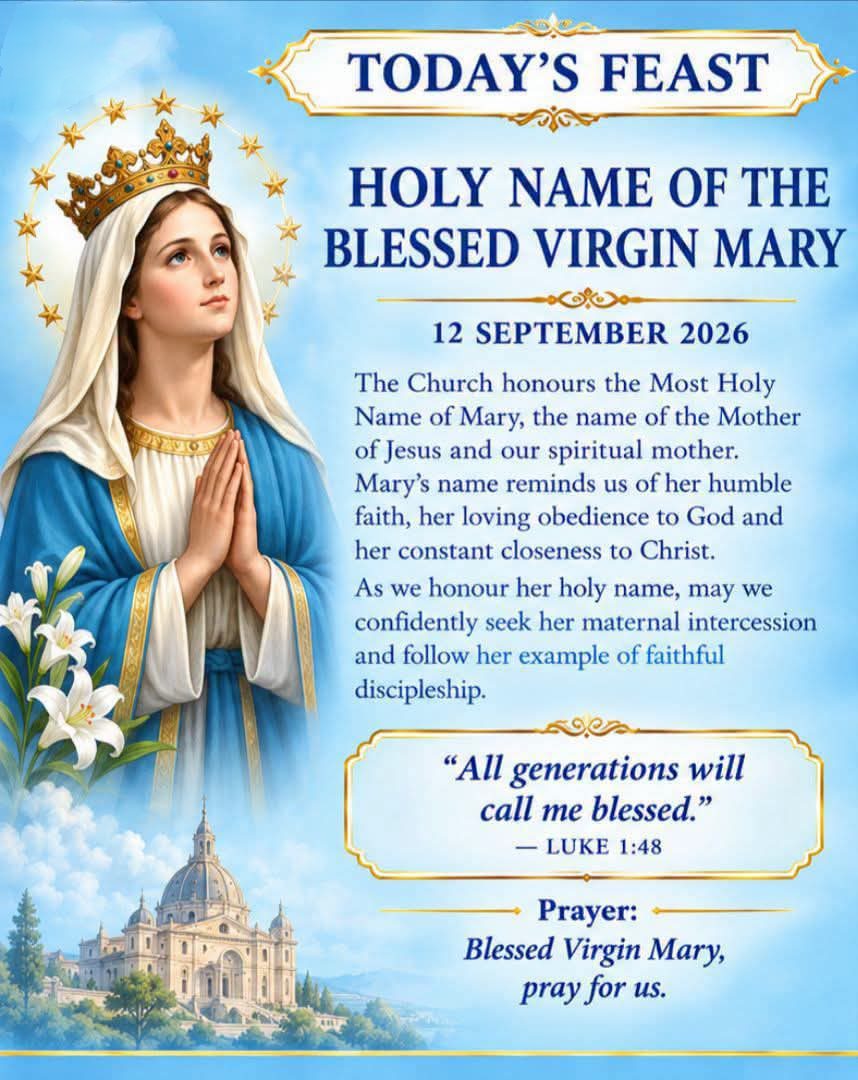
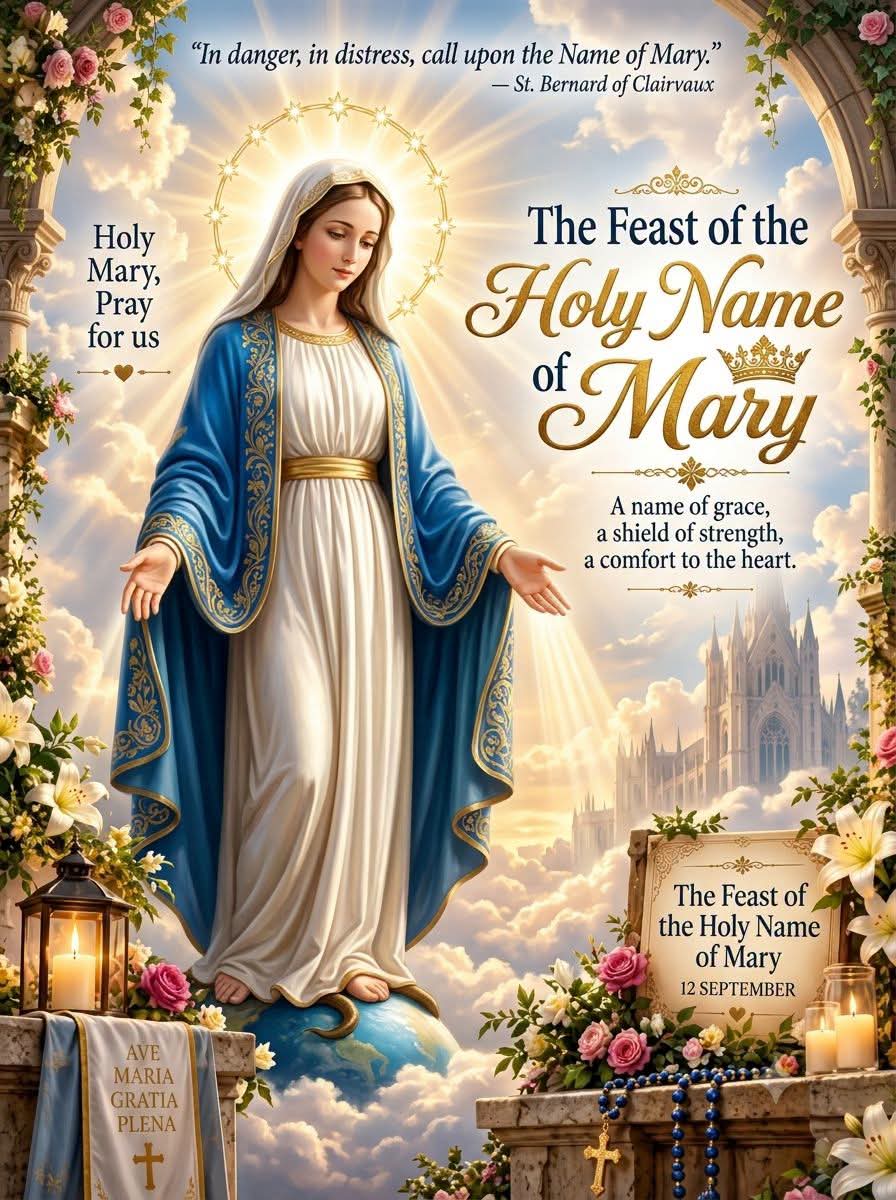
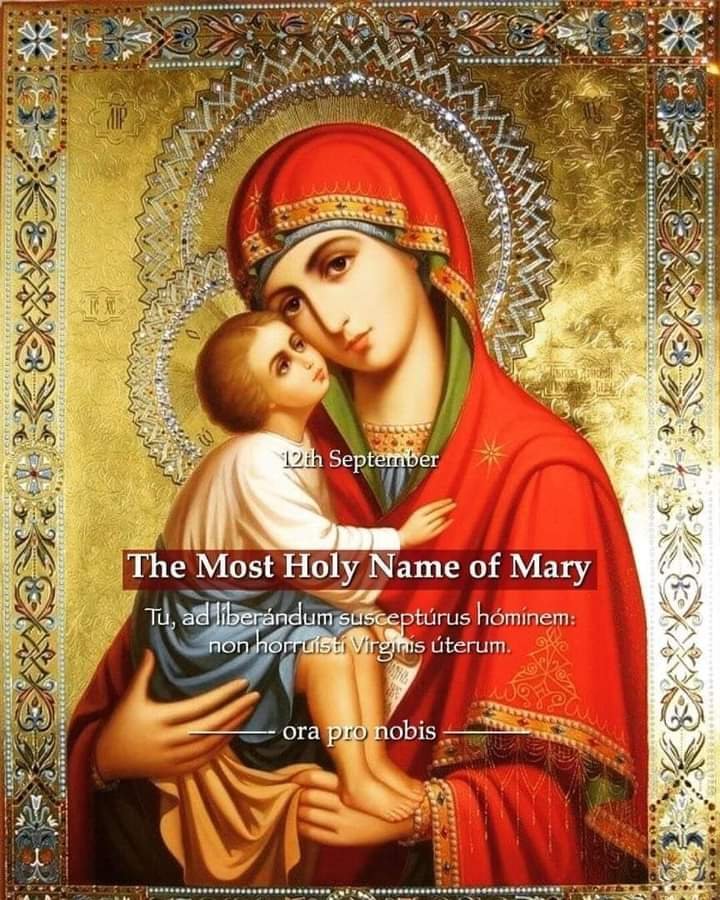
FEAST OF THE MOST HOLY NAME OF THE BLESSED VIRGIN MARY – 12th SEPTEMBER
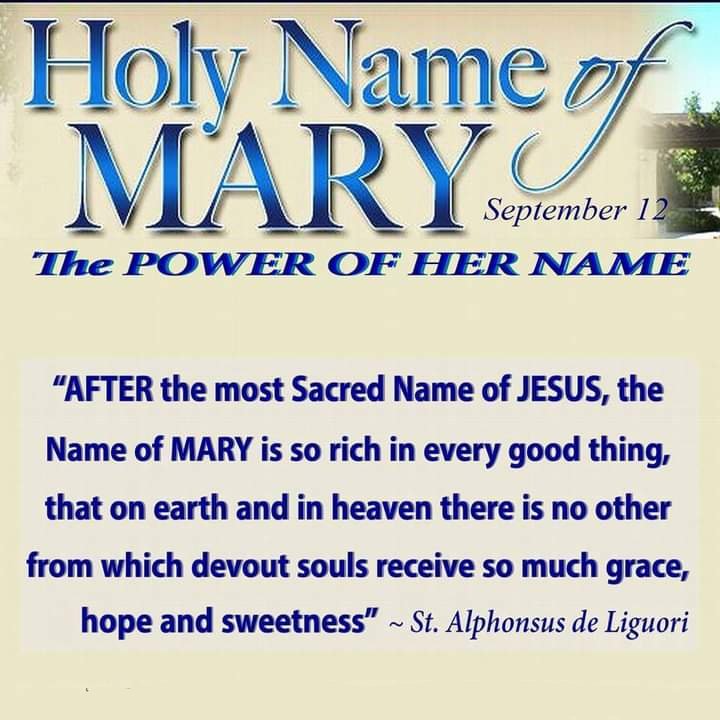
The Feast of the Most Holy Name of the Blessed Virgin Mary is an optional memorial celebrated in the liturgical calendar of the Catholic Church on 12 September. It has been a universal Roman Rite feast since 1684, when Pope Innocent XI included it in the General Roman Calendar to commemorate the victory at the Battle of Vienna in 1683.
It was removed from the Church calendar in the liturgical reform following Vatican II but restored by Pope John Paul II in 2002, along with the Feast of the Holy Name of Jesus. In Hebrew, the name Mary is “Miryam”. In Aramaic, the language spoken in her own time, the form of the name was “Mariam”. Based on the root “merur”, the name signifies “bitterness”. This is reflected in the words of Naomi, who, after losing a husband and two sons lamented, ” “Do not call me Naomi (‘Sweet’). Call me Mara (‘Bitter’), for the Almighty has made my life very bitter.”

Meanings ascribed to Mary’s name by the early Christian writers and perpetuated by the Greek Fathers include: “Bitter Sea,” “Myrrh of the Sea”, “The Enlightened One,” “The Light Giver,” and especially “Star of the Sea.” Stella Maris was by far the favored interpretation. Jerome suggested the name meant “Lady”, based on the Aramaic “mar” meaning “Lord”. In the book, The Wondrous Childhood of the Most Holy Mother of God, St. John Eudes offers meditations on seventeen interpretations of the name “Mary,” taken from the writings of “the Holy Fathers and by some celebrated Doctors”.
The name of Mary is venerated because it belongs to the Mother of God. Mary’s name occurs in the first part and in the second part of the Hail Mary. At Rome, one of the twin churches at the Forum of Trajan is dedicated to the Name of Mary (Santissimo Nome di Maria al Foro Traiano). Promoters of veneration of the Holy Name of Mary include: Saint Anthony of Padua, Saint Bernard of Clairvaux, and Saint Alphonsus Maria de Liguori.
A number of religious orders such as the Cistercians, customarily give each member “Mary” as part of his/her name in religion as a sign honor and of entrustment to her. The feast day began in 1513 as a local celebration in Cuenca, Spain, celebrated on 15 September. In 1587 Pope Sixtus V moved the celebration to 17 September.
Pope Gregory XV extended the celebration to the Archdiocese of Toledo in 1622. In 1666 the Discalced Carmelites received permission to recite the Divine Office of the Name of Mary four times a year.
In 1671 the feast was extended to the whole Kingdom of Spain. From there, the feast spread to all of Spain and to the Kingdom of Naples. In 1683, the Polish king, John Sobieski, arrived at Vienna with his army.
Before the Battle of Vienna, Sobieski placed his troops under the protection of the Blessed Virgin Mary. In the following year, to celebrate the victory, Pope Innocent XI added the feast to the General Roman Calendar, assigning to it the Sunday within the octave of the Nativity of Mary.
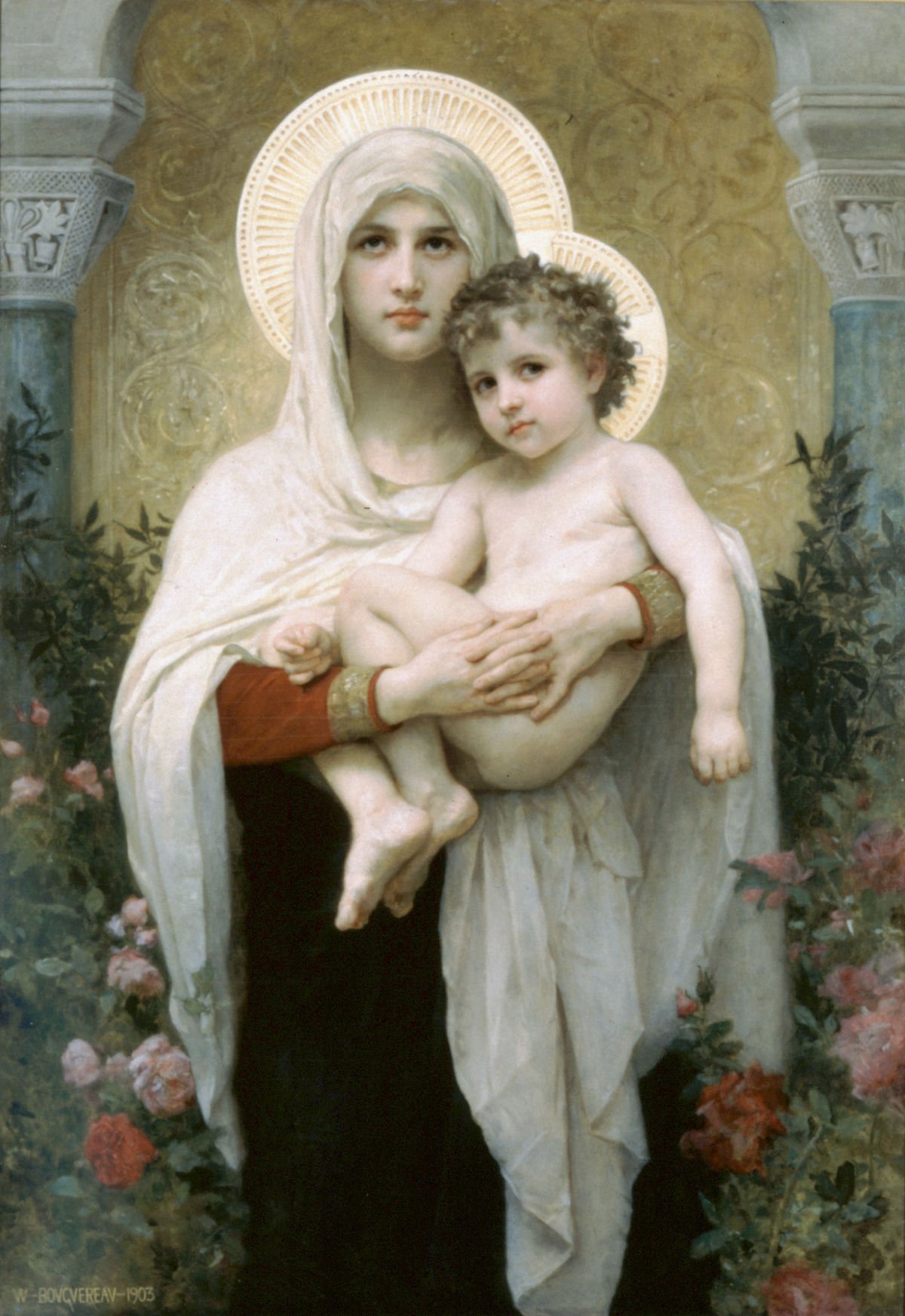
The reform of Pope Pius X in 1911 restored to prominence the celebration of Sundays in their own right, after they had been often replaced by celebrations of the saints. The celebration of the Holy Name of Mary was therefore moved to 12 September. Later in the same century, the feast was removed from the General Roman Calendar in 1969 in the reform of the Calendar by Pope Paul VI, as something of a duplication of the 8 September feast of the Nativity of the Blessed Virgin Mary.
But it did not cease to be a recognized feast of the Roman Rite, being mentioned in the Roman Martyrology on 12 September. In 2002 Pope John Paul II restored the celebration of the Name of Mary to the General Roman Calendar.
“If you ever feel distressed during your day — call upon our Lady — just say this simple prayer: ‘Mary, Mother of Jesus, please be a mother to me now.’ I must admit — this prayer has never failed me.” – St. Teresa of Calcutta
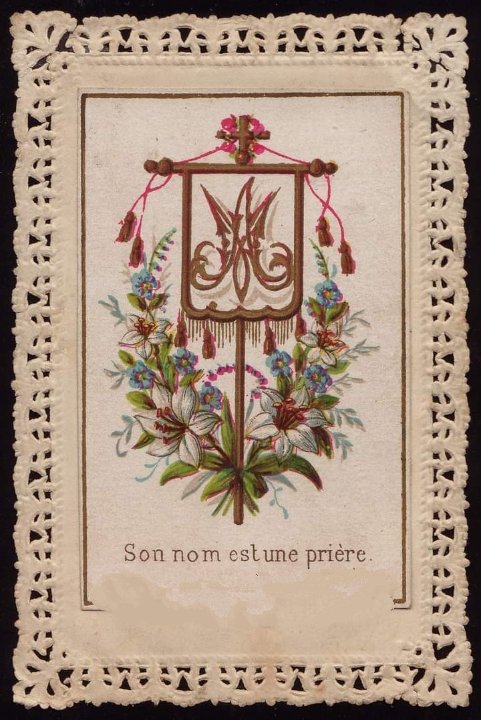
This most holy, sweet and worthy name was ’eminently fitted to so holy, sweet and worthy a virgin. For Mary is interpreted Lady. Mary is a bitter sea to the demons; to men she is the Star of the sea; to the Angels she is illuminatrix, and to all creatures she is Lady.” [St. Bonaventure +1274]
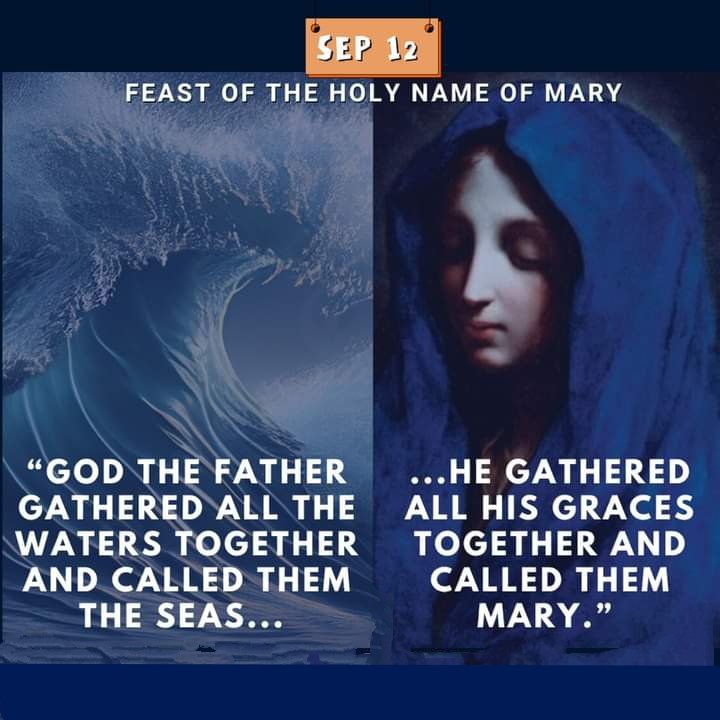
“God the Father gathered all the waters together and called them the seas or maria [Latin, seas]. He gathered all His grace together and called it Mary or Maria . . . This immense treasury is none other than Mary whom the saints call the ‘treasury of the Lord.’ From her fullness all men are made rich.” [St. Louis de Montfort +1716]
It is not difficult to see why these various interpretations of the name “Mary” should have been proposed and cherished, for they encapsulate many of our Marian doctrines and beliefs.
Among the many, one interpretation for the name “Mary” highlights the relationship of the Blessed Virgin Mary to the Church. It is derived from the Hebrew verb mara, meaning “to be fleshy or robust” and implicitly pointing to Our Lady’s beauty and spiritual fecundity. She is the Tota Pulchra, the Beautiful One.
A name doesn’t imply that you know everything about someone, but it does make a person “invocable.” To know that there is a “someone” standing before you is not to know too much.
When that “someone” has a name, however, he or she is placed in relationship with you, and relationships are what matter most. By means of a name, we go beyond a mere concept, beyond a mere thing.
CONTEMPLATING THE MOST HOLY NAME OF MARY
THE STORY OF THE MOST HOLY NAME OF MARY
A name is a precious gift that makes us feel known, loved and remembered. In a special way, the Church cherishes the name of Mary, the Mother of Jesus. When her name is spoken with love and trust, it brings comfort and reminds us of her maternal care.
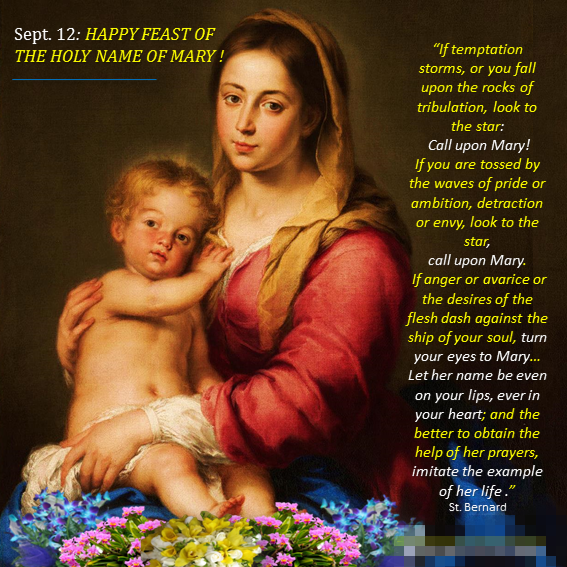
From the early centuries, Christians have called upon Mary in times of fear, temptation and difficulty. Saints such as Bernard of Clairvaux encouraged the faithful to think of Mary and invoke her holy name, trusting in her powerful intercession and motherly protection.
THE BATTLE OF VIENNA AND MARY’S HELP
In 1683, Vienna was besieged by the Ottoman army, and the people faced great fear and suffering. Within the city, Christians prayed fervently and cried out to Mary for help.
King Jan III Sobieski of Poland, a devout Catholic, came to the aid of Vienna with his army. Before the battle, he and his soldiers prayed and entrusted themselves to Mary. On September 12, his forces defeated the Ottoman army and Vienna was saved.
The victory was gratefully attributed to God’s providence and Mary’s maternal intercession. In thanksgiving, Pope Innocent XI established the Feast of the Most Holy Name of Mary for the universal Church on September 12.
MORE THAN A MEMORY
The feast of the Most Holy Name of Mary is not merely a remembrance of a historical victory. It reminds us that we too face many battles: fear, temptation, family difficulties, loneliness, illness and uncertainty.
When we call upon Mary with faith, her name can bring peace and courage to our troubled hearts. She always leads us to Jesus and gently reminds us, “Do whatever He tells you.”
The name of Mary is like a light in darkness. It reminds us that we are not abandoned and that our heavenly Mother continually intercedes for us and leads us closer to her Son.
PRAYER TO THE MOST HOLY NAME OF MARY
O Most Holy Name of Mary,
sweet on our lips and strong in our battles,
gentle in our sorrows,
you are our Mother and our guide.
When we are afraid,
let your name give us courage.
When we are lost,
lead us to Jesus.
When we are weary,
be our comfort and rest.
Bless us, O Mary,
that by calling upon your holy name,
we may always remain in the love of Christ your Son. Amen
PRAYER
Dear Virgin Mary, may your most holy name be venerated and honored, because you enjoy greater closeness to God than anyone else, because you know him being in more proximity than we are, and because we pray and trust that you will be with us now and at the hour of our death.
We are presented to Christ by you, his Mother. You present our needs and petitions to him and are the instrument of his mercy and of the disposition of the “Treasury of Grace” won by him for us on Calvary. You impart the maternal peace’ and happiness to us, in this valley of tears, giving us nothing less than the peace of Christ.
We may struggle to maintain this peace in our bruised and weary hearts, but you are always ready and eager to share it with us again and again.
The name of ‘Mary’, your most beautiful yet simple name, speaks volumes to us. “There is hidden in that Divine name [of Mary] a spell so potent,” wrote Abbé Orsini, “and of such marvelous sweetness, that merely to pronounce it softens the heart, merely to write it beautifies the style.” St. Bonaventure declared that the name of Mary “cannot be pronounced without bringing some grace to him who does so devoutly.” Mother Mary, always shelter us under your most precious mantle and at the end of our life reveal to us the fruit of your womb Jesus. Amen