
TODAY’S GOSPEL READING – 3 OCTOBER
October 3, 2026
FEAST OF SAINT FRANCIS OF ASSISI – 4th OCTOBER
October 4, 2026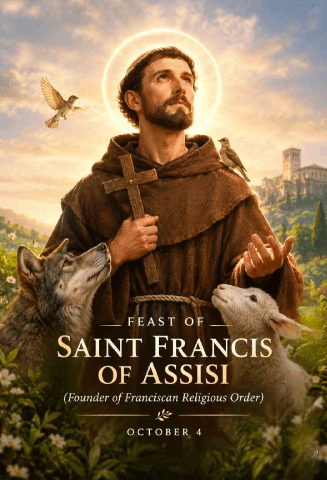
A HEART TRANSFORMED BY GOD
“Therefore, if anyone is in Christ, there is a new creation: everything old has passed away; see, everything has become new.”
— 2 Corinthians 5:17
Francis began life as a joyful young man attracted to wealth, popularity, festivities and the dream of becoming a knight. After imprisonment, illness and a profound spiritual awakening, his desires gradually changed. He began seeking God rather than worldly glory. His conversion reminds us that no heart is beyond the transforming grace of God.
LOVING CHRIST IN THE POOR AND SUFFERING
Jesus Himself speaks of the special care God has for children and the humble. He teaches that their angels continually behold the presence of God, revealing the dignity and heavenly protection given to His little ones.
“Truly I tell you, just as you did it to one of the least of these who are members of my family, you did it to me.”
— Matthew 25:40
Francis had a deep fear of lepers, yet one day he overcame himself, approached a leper, embraced him and showed him compassion. This encounter became a decisive moment in his conversion. What had once seemed bitter became, through God’s grace, a source of sweetness.
REPAIRING WHAT IS BROKEN
“Go and repair my house, which, as you see, is falling into ruin.”
— See 1 Corinthians 3:9
While praying before the crucifix at the neglected chapel of San Damiano, Francis received what he understood as Christ’s call to repair God’s house. He first repaired physical churches, but his life eventually became a deeper work of renewal within the Church through radical Gospel living.
THE JOY OF GOSPEL POVERTY
“Do not store up for yourselves treasures on earth, where moth and rust consume and where thieves break in and steal.”
— Matthew 6:19
Francis freely embraced poverty and simplicity, choosing to possess little so that his heart could belong completely to Christ. At the Portiuncula, hearing the Gospel concerning the mission of the apostles and their simple way of life, he recognized the path he desired to follow. His poverty was not emptiness but freedom to love God and neighbour without being possessed by possessions.
PEACE INSTEAD OF WAR
“Blessed are the peacemakers, for they will be called children of God.”
— Matthew 5:9
The young Francis once dreamed of military glory and knighthood. Yet after experiencing war, imprisonment and illness, God redirected his desire for greatness towards a different kind of knighthood: service to Christ and His people. The man who once desired the glory of battle became a humble messenger of peace.
A BROTHER TO ALL CREATION
“All things came into being through him, and without him not one thing came into being.”
— John 1:3
Francis saw creation as a gift flowing from the goodness of the Creator. He called the sun, moon, earth, water and other creatures his brothers and sisters, because everything proclaimed the glory of God. His Canticle of the Creatures expressed this profound reverence, gratitude and praise.
COMPASSION THAT CROSSES BARRIERS
“Love your enemies and pray for those who persecute you.”
— Matthew 5:44
Francis was willing to cross boundaries that others considered impossible. In 1219 he travelled to Egypt and met Sultan Malik al-Kamil during the Crusades. Rather than approaching another religious community with hatred, he sought dialogue and bore witness to Christ with humility and peace.
MAKING CHRIST PRESENT IN SIMPLE WAYS
“For I have set you an example, that you also should do as I have done to you.”
— John 13:15
At Greccio in 1223, Francis arranged a living representation of the Nativity so that people could contemplate the humility of Christ coming among us as a little child. His love for the Incarnation enabled ordinary people to encounter the mystery of Christmas with renewed wonder and devotion.
BECOMING LIKE CHRIST THROUGH SUFFERING
“I want to know Christ and the power of his resurrection and the sharing of his sufferings by becoming like him in his death.”
— Philippians 3:10
At La Verna in 1224, while absorbed in prayer and meditation on the Passion of Christ, Francis experienced the extraordinary event traditionally associated with receiving the stigmata. His deepest desire was not honour or recognition, but conformity to the suffering and self-giving love of Jesus.
JOY EVEN IN SUFFERING
“Rejoice in the Lord always; again I will say, Rejoice.”
— Philippians 4:4
Francis endured serious illness, physical weakness, failing eyesight and suffering during the final years of his life. Yet suffering did not destroy his joy. While suffering at San Damiano, he composed the Canticle of the Creatures, praising God for creation and ultimately welcoming even death as a sister.
HUMILITY UNTIL THE END
“He must increase, but I must decrease.”
— John 3:30
Although thousands eventually followed his way of life, Francis remained deeply conscious that everything good came from God. He did not seek worldly power or personal glory. He died at the Portiuncula on 3 October 1226, leaving behind a life that proclaimed the Gospel through simplicity, humility and love.
A LIFE THAT BECAME A LIVING GOSPEL
“Whoever wants to become great among you must be your servant.”
— Matthew 20:26
Saint Francis teaches us that holiness is not merely knowing the Gospel but allowing the Gospel to become visible in our daily lives. His embrace of the rejected, love of the poor, devotion to Christ, reverence for creation, commitment to peace, acceptance of suffering and joyful poverty transformed him into a living reflection of Jesus.
PRAYER
Heavenly Father, through the example of Saint Francis of Assisi, teach us to love You with an undivided heart. Free us from attachment to wealth, pride, comfort and worldly recognition. Give us the courage to see Christ in the poor, the suffering, the lonely and the forgotten. Make us instruments of Your peace wherever there is hatred, forgiveness wherever there is injury, hope wherever there is despair and love wherever there is loneliness.
Lord Jesus, help us to follow You with the humility and simplicity of Saint Francis. Teach us to embrace Your Cross with faith, to praise You in times of joy and suffering, and to recognize Your goodness in all creation. May our lives become a living Gospel, reflecting Your mercy, peace and love.
Saint Francis of Assisi, pray for us, and help us to become instruments of peace and faithful followers of Christ. Amen.