
TODAY’S GOSPEL READING – 2 SEPTEMBER
September 2, 2026
FEAST OF SAINT GREGORY THE GREAT, POPE AND DOCTOR OF THE CHURCH – 3rd SEPTEMBER
September 3, 2026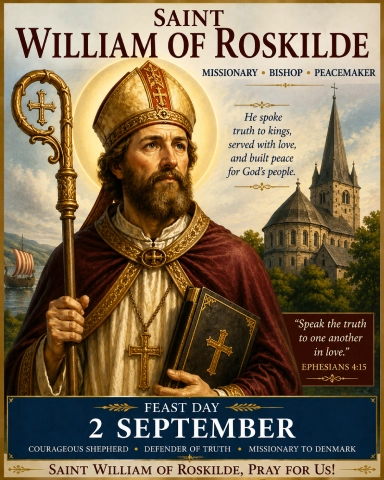
GOD SOMETIMES CALLS US AWAY FROM WHAT IS FAMILIAR
“Go from your country and your kindred and your father’s house to the land that I will show you.”
— Genesis 12:1
Saint William was an English priest and chaplain of King Canute who travelled to Denmark. Moved by the spiritual needs he witnessed there, he chose to remain and proclaim the Gospel among the Danish people. His decision reminds us that God may lead us beyond familiar surroundings so that our gifts can serve a greater purpose. What first appears to be a departure from security may become the beginning of a deeper vocation.
MISSION MEANS LOVING PEOPLE BEFORE THEY BECOME OUR PEOPLE
“Go therefore and make disciples of all nations.”
— Matthew 28:19
William did not limit his ministry to people of his own country or culture. He embraced Denmark as his mission field and eventually became Bishop of Roskilde. His life shows that Christian love crosses boundaries of nationality, language and background. God calls us to see every person as someone entrusted to our care.
A TRUE FRIEND SOMETIMES HAS TO TELL THE TRUTH
“Faithful are the wounds of a friend, but profuse are the kisses of an enemy.”
— Proverbs 27:6
William was a trusted counsellor of King Sweyn Estridsen, but he did not allow friendship with the king to silence his conscience. When the king ordered men to be executed without proper trial, William courageously confronted him. True friendship is not merely agreeing with another person; it is loving them enough to speak the truth when they are going in the wrong direction.
SPIRITUAL AUTHORITY IS NOT POLITICAL POWER
“You shall not lord it over them, but whoever would be great among you must be your servant.”
— Matthew 20:26
William possessed no army or worldly power, yet he could stand before a king with the authority of conscience and faith. His influence came from his fidelity to God rather than from political strength. His example reminds us that Christian authority is strongest when it is rooted in holiness, truth and service.
FEAR CAN SILENCE THE TRUTH
“Do not fear those who kill the body but cannot kill the soul”
— Matthew 10:28
When William confronted King Sweyn, he knew that the king possessed the power to punish him. According to tradition, William stood at the church entrance and boldly rebuked the king for the unjust killings. He teaches us that courage does not mean having no fear. It means refusing to allow fear to prevent us from doing what is right.
TRUTH WITHOUT LOVE IS NOT CHRISTIAN COURAGE
“Speaking the truth in love, we are to grow up in every way into him who is the head, into Christ.”
— Ephesians 4:15
William’s courageous correction of the king was not motivated by hatred or a desire to humiliate him. When Sweyn later repented, William welcomed him and restored their friendship. His example shows that correction should aim at conversion and healing. Christian courage joins truth with charity, firmness with humility and justice with mercy.
REAL PEACE SOMETIMES REQUIRES CONFRONTATION
“Blessed are the peacemakers, for they shall be called sons of God.”
— Matthew 5:9
William’s confrontation with King Sweyn disturbed the outward peace of the moment, but it opened the way for repentance and reconciliation. The king eventually acknowledged his wrongdoing and sought forgiveness. William teaches us that genuine peace is not simply the absence of disagreement. Sometimes courageous confrontation is necessary to remove injustice and allow true peace to take root.
LEADERSHIP IS STEWARDSHIP, NOT OWNERSHIP
“Whoever would be great among you must be your servant.”
— Mark 10:43
As Bishop of Roskilde, William understood that his position was a responsibility entrusted to him by God. He worked for the strengthening of the Church and began the construction of the first stone church at Roskilde, a work completed by his successor. His life reminds every parent, priest, teacher and leader that those entrusted to our care belong ultimately to God.
THE GREATEST LEADERSHIP IS WHAT CONTINUES AFTER WE ARE GONE
“Teach them to observe all that I have commanded you; and behold, I am with you always.”
— Matthew 28:20
William’s ministry helped strengthen the Christian life of Denmark, and his work in Roskilde continued beyond his own lifetime. The church building he began was completed by his successor. His example reminds us that our success should not be measured only by what we accomplish personally, but also by what we leave behind for others to continue.
THE CROSS GIVES COURAGE BEFORE EVERY KING
“You shall worship the Lord your God and him only shall you serve.”
— Matthew 4:10
William stood before an earthly king because he knew that his ultimate allegiance belonged to God. Every age has its own kings: power, money, popularity, public opinion, fear and the desire for acceptance. Saint William reminds us that when Christ is truly King of our hearts, no earthly authority can demand our ultimate obedience.
PRAYER THROUGH THE INTERCESSION OF SAINT WILLIAM OF ROSKILDE
O Saint William of Roskilde, faithful shepherd, courageous truth teller, missionary and peacemaker, you left the familiarity of your homeland to serve God among people of another land.
Obtain for us the courage to follow God’s call even when it leads us beyond what is familiar and comfortable. Teach us to welcome every person with love and to see each one as someone entrusted to our care.
Give us the courage to speak the truth with charity, to correct without humiliating, to forgive without abandoning justice and to seek peace without compromising truth.
When we are afraid of those who possess worldly power, remind us that our ultimate allegiance belongs to Jesus Christ, our true King.
Pray for bishops, priests, parents, teachers, leaders and all who have been entrusted with the care of others. May they exercise authority with humility and use their influence for the good of those they serve.
Help us to become people whose presence brings truth, whose words bring wisdom, whose correction brings healing and whose lives bring peace.
May we never choose the comfort of silence when love requires us to speak, nor the harshness of truth when love requires us to be gentle.
Saint William of Roskilde, courageous shepherd, missionary, defender of truth and peacemaker, pray for us.
Through Christ our Lord. Amen.