
TODAY’S GOSPEL READING – 24 FEBRUARY
February 24, 2026
SPIRITUAL INSIGHTS INTO THE LIFE OF SAINT JOHN THERISTUS FEAST DAY
February 24, 2026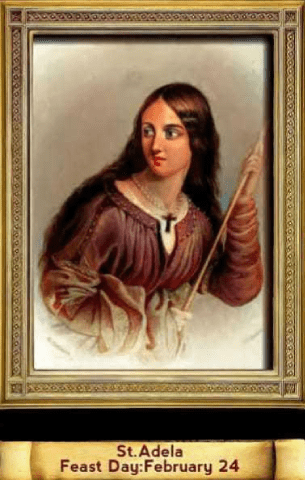
FAITHFULNESS IN ROYAL RESPONSIBILITY
“Moreover, it is required of stewards that they be found faithful.”
— 1 Corinthians 4:2
Saint Adela of Normandy was born into royalty as the daughter of William the Conqueror. She married Stephen, Count of Blois, and became a noblewoman with immense political responsibility. When her husband left to join the First Crusade, Adela governed his territories with wisdom and firmness. She was not merely a ruler by title but a steward who saw her authority as entrusted by God.
Her governance was marked by justice, stability, and concern for the Church. She proved that leadership is a vocation when exercised with integrity. Adela teaches us that holiness is possible even in positions of power when responsibility is embraced as service.
COURAGE TO CALL OTHERS TO THEIR HIGHER CALLING
“Encourage one another and build one another up.”
— 1 Thessalonians 5:11
When Stephen of Blois abandoned the First Crusade and returned home prematurely, Adela did not remain silent. She courageously urged him to return and fulfill his vow. Her words and influence helped move him to rejoin the Crusade, where he later died.
This incident reveals her moral strength. She did not allow comfort or fear to overshadow duty and honor. Adela shows us that true love sometimes challenges rather than comforts. Encouraging others to live faithfully to their commitments is an act of deep charity.
FORMING SAINTS THROUGH HOLY PARENTHOOD
“Train up a child in the way he should go; even when he is old he will not depart from it.”
— Proverbs 22:6
Adela’s motherhood bore extraordinary fruit. Among her children was Stephen, who became King of England, and Henry of Blois, who became Bishop of Winchester. Most notably, her daughter Adela (also known as Matilda) entered religious life.
After her husband’s death, Adela continued to guide her children with spiritual seriousness. She ensured they received strong Christian formation and education. Through her, we see that sanctity often begins in the home. The faith she instilled influenced not only her family but the political and ecclesial life of her time.
DETACHMENT AFTER DUTY
“What does it profit a man to gain the whole world and forfeit his soul?”
— Mark 8:36
After years of governing and fulfilling her responsibilities, Adela made a radical decision. She withdrew from public life and entered the Abbey of Marcigny in France. A woman accustomed to courtly influence chose the quiet life of prayer and humility.
Her transition from noble authority to monastic simplicity shows spiritual maturity. She understood that earthly honor fades, but communion with God endures. Adela’s life reminds us that success is not the final goal—union with God is.
HUMILITY CROWNS GREATNESS
“God opposes the proud but gives grace to the humble.”
— James 4:6
Though she was born into greatness and exercised power wisely, Adela did not cling to status. In the monastery, she lived as one among many, seeking holiness in hiddenness.
Her final years were marked not by political influence but by prayer, repentance, and preparation for eternity. She died around 1137, remembered not merely as a countess, but as a woman of faith.
Saint Adela of Normandy teaches us that sanctity is not confined to cloisters or crowns. Whether governing nations or kneeling in silence, the heart that seeks God above all becomes truly noble.