
TODAY’S GOSPEL READING – 17 APRIL
April 17, 2026
FEAST OF SAINT APOLLONIUS THE APOLOGIST, MARTYR – 18 APRIL
April 18, 2026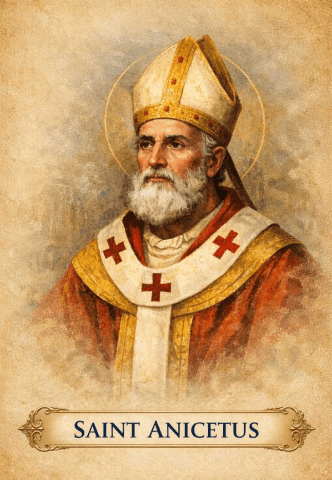
A CHURCH IN TRANSITION AFTER THE APOSTLES
“Guard the good deposit entrusted to you with the help of the Holy Spirit.”
— 2 Timothy 1:14
The absence of the Apostles did not weaken the Church but called for deeper faithfulness to their teaching. Saint Anicetus lived in a time when the Church had to stand firmly on what had been handed down. He guided the faithful to remain rooted in apostolic tradition even without direct apostolic leadership.
Incident: As Pope, Anicetus ensured continuity in teaching and worship, preserving what he had received from earlier leaders of the Church.
Every generation must receive and safeguard the faith anew.
THE RISE OF GNOSTIC TEACHINGS
“See to it that no one takes you captive through hollow and deceptive philosophy.”
— Colossians 2:8
False teachings began to spread, claiming secret or higher knowledge. These ideas distorted the true message of Christ. Anicetus recognized the danger and upheld the truth that Christ came fully in human flesh for the salvation of all.
Incident: During his papacy, he opposed early Gnostic influences that denied the humanity of Christ, helping the Church remain grounded in truth.
Not all higher knowledge leads to truth.
DOCTRINAL DISTORTIONS WITHIN THE CHURCH
“A little yeast works through the whole batch of dough.”
— Galatians 5:9
Even small errors can lead to great confusion. Anicetus understood the need for vigilance and clarity in teaching. He ensured that doctrine remained faithful to apostolic tradition.
Incident: He addressed emerging misunderstandings within Christian communities, guiding them gently but firmly back to the truth.
Error often begins subtly.
ANICETUS’ RESPONSE TO ERROR
“Then you will know the truth, and the truth will set you free.”
— John 8:32
Anicetus did not react with fear or aggression but with steady faithfulness. He anchored the Church in what had already been revealed and handed down.
Incident: Instead of creating new responses, he reinforced established teachings, showing that stability comes from rootedness in truth.
Truth is best preserved through faithful witness.
MEETING WITH SAINT POLYCARP OF SMYRNA
“Let us therefore make every effort to do what leads to peace and to mutual edification.”
— Romans 14:19
Differences arose regarding the date of celebrating Easter. Yet Anicetus and Saint Polycarp remained united in charity despite disagreement.
Incident: When Saint Polycarp visited Rome, the two discussed their differences respectfully. Though they did not agree, they maintained communion, and Anicetus even allowed Polycarp to celebrate the Eucharist.
Unity does not require uniformity.
HANDLING CONFLICT WITHOUT DIVISION
“Make every effort to keep the unity of the Spirit through the bond of peace.”
— Ephesians 4:3
Anicetus showed that truth and charity must go together. Without truth, there is confusion; without charity, there is division.
Incident: His peaceful handling of disagreements set an example for future Church leaders on maintaining unity amid diversity.
Leadership is the art of holding tension without breaking unity.
QUIET AND STEADY LEADERSHIP
“Stand firm. Let nothing move you. Always give yourselves fully to the work of the Lord.”
— 1 Corinthians 15:58
Anicetus’ leadership was not marked by dramatic events but by faithful consistency. His quiet strength helped shape the Church during a formative time.
Incident: Though not widely known for grand actions, his steady governance ensured stability during a period of doctrinal challenges.
The most important work is often unseen.
PRESERVING THE APOSTOLIC FAITH
“Contend for the faith that was once for all entrusted to God’s holy people.”
— Jude 1:3
Authentic renewal is always rooted in continuity. Anicetus remained faithful to what had been entrusted to him, ensuring that the Church did not lose its foundation.
Incident: He safeguarded the traditions passed down from the Apostles, strengthening the Church’s identity for future generations.
The Church lives by what it receives, not what it invents.
PRAYER THROUGH THE INTERCESSION OF SAINT ANICETUS
Lord God,
who guided Saint Anicetus
to preserve truth and unity in Your Church,
grant us the wisdom to discern rightly,
the courage to remain faithful,
and the charity to live in unity.
Help us to hold fast to what is true
while loving one another deeply.
Through Christ our Lord.
Amen.